
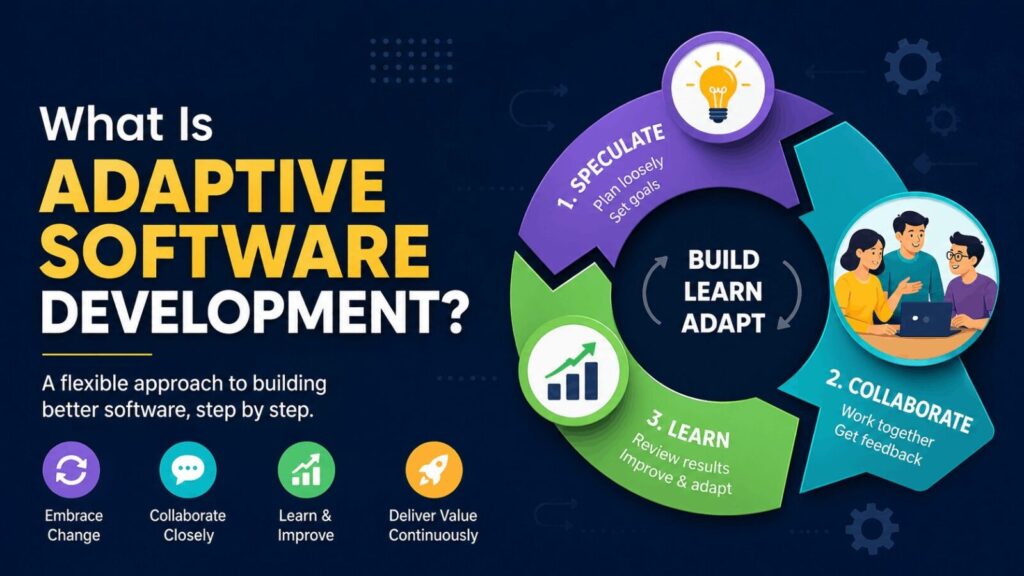
So, what is adaptive software development?
Honestly, it’s just a way of building software where you don’t try to lock everything in at the start. Because… well, things change. Always do.
Requirements change. Users change their minds. Even the team learns new stuff while building. So instead of fighting all that, Adaptive Software Development (ASD) just… works with it.
A bit messy? Yeah. But also very realistic.
What Is Adaptive Software Development (in simple words)
Adaptive Software Development is basically a flexible way of making software where:
- You don’t plan everything upfront
- You keep adjusting as you go
- You learn from feedback
- And you keep improving step by step
It’s not strict. Not rigid. More like “we’ll figure it out while building it.”
Which, to be honest, is how most real projects already work.
Why this approach even exists
Old methods like Waterfall worked when everything was stable.
But now?
Not really stable anymore.
- Clients change requirements mid-way
- New features come up suddenly
- Technology updates fast
- Market needs shift quickly
So developers needed something more flexible. Something that doesn’t break when plans change.
That’s where ASD comes in.
The basic idea behind it
If you want the simplest explanation:
Don’t plan everything. Build, learn, adjust.
That’s it.
Not very fancy. But very practical.
The 3 main phases of Adaptive Software Development
ASD usually follows three stages. They sound formal, but they’re actually simple.
1. Speculate (basically planning… but loosely)
This is where you don’t create a strict plan.
Instead you:
- Guess what needs to be built
- Set rough goals
- Make assumptions
And yeah… some of it will change later. That’s expected.
2. Collaborate (the real work happens here)
This is where everyone works together.
- Developers talk a lot
- Users give feedback
- Teams adjust constantly
Not much “work in isolation” here. It’s more like constant discussion and correction.
3. Learn (very important part)
This is where you step back and see what happened.
- What worked?
- What failed?
- What needs change?
Then you improve the next cycle.
And this repeats again and again.
How the process actually works (step by step)
Let’s make it even easier:
- You start with a rough idea
- Build a small version
- Show it to users
- Get feedback (sometimes harsh, sometimes useful)
- Fix and improve
- Repeat
That loop… keeps going until the product feels right.
Key things that make ASD different
- Change is normal here
- Planning is flexible
- Feedback is constant
- Teams work closely
- Everything happens in small steps
Nothing is fully “final” until the end.
Adaptive Software Development vs traditional methods
Here’s a simple comparison:
| Thing | Adaptive Software Development | Traditional (Waterfall) |
|---|---|---|
| Planning | Flexible, rough | Fixed, detailed |
| Changes | Expected | Avoided |
| Feedback | Happens all the time | Mostly at the end |
| Process | Repeats in cycles | One straight path |
| Risk | Lower in changing projects | Higher if things change |
So yeah… ASD is more “real world friendly.”
Advantages (why people like it)
There are some desirable reasons people use it:
- It handles change easily
- You don’t waste time on rigid plans
- You get feedback early
- Mistakes are caught quickly
- Product improves step by step
In short: less guessing, more learning.
Disadvantages (it’s not perfect)
Of course, nothing is perfect.
- Hard to predict final outcome
- Needs strong communication
- Can feel messy sometimes
- Not great for very strict projects
- Teams need experience to handle it well
So yeah, it’s flexible… but that flexibility needs discipline too.
When should you actually use it?
Adaptive Software Development fits best when:
- You’re building something new
- Requirements are unclear
- Users are actively giving feedback
- The project is changing often
Like startups, apps in early stages, or experimental tech projects.
But if everything is fixed from day one… maybe not the best choice.
Simple real-life example
Let’s say you’re building a food delivery app.
With ASD:
- You launch a basic version first
- Users start using it
- They say “we want faster checkout”
- You add improvements
- Then maybe add tracking later
So instead of planning everything in advance… you build it step by step based on real use.
Why it matters today
Modern software changes too fast.
Honestly, by the time you fully plan something, half the requirements might already feel outdated.
That’s why ASD is useful—it keeps things flexible.
Not perfect. But realistic.
FAQs About What is Adaptive Software Development
What is adaptive software development?
It’s a flexible way of building software wherein you adapt and improve constantly as opposed to following a hard and fast plan.
What are the principle stages?
Speculate, Collaborate, and learn.
Is it higher than traditional methods?
Depends. It’s better for changing tasks, not constant ones.
Is it hard to use?
It may be, particularly if the team is not used to flexibility.
Why do developers use it?
Because real projects change often, and ASD handles that better.
Conclusion
So, what is adaptive software development?
It’s basically a “build, learn, adjust” way of making software. Nothing too complicated.
It accepts that plans will change. And instead of resisting that, it just adapts.
Not always neat. Not always predictable. But in today’s world… pretty practical.