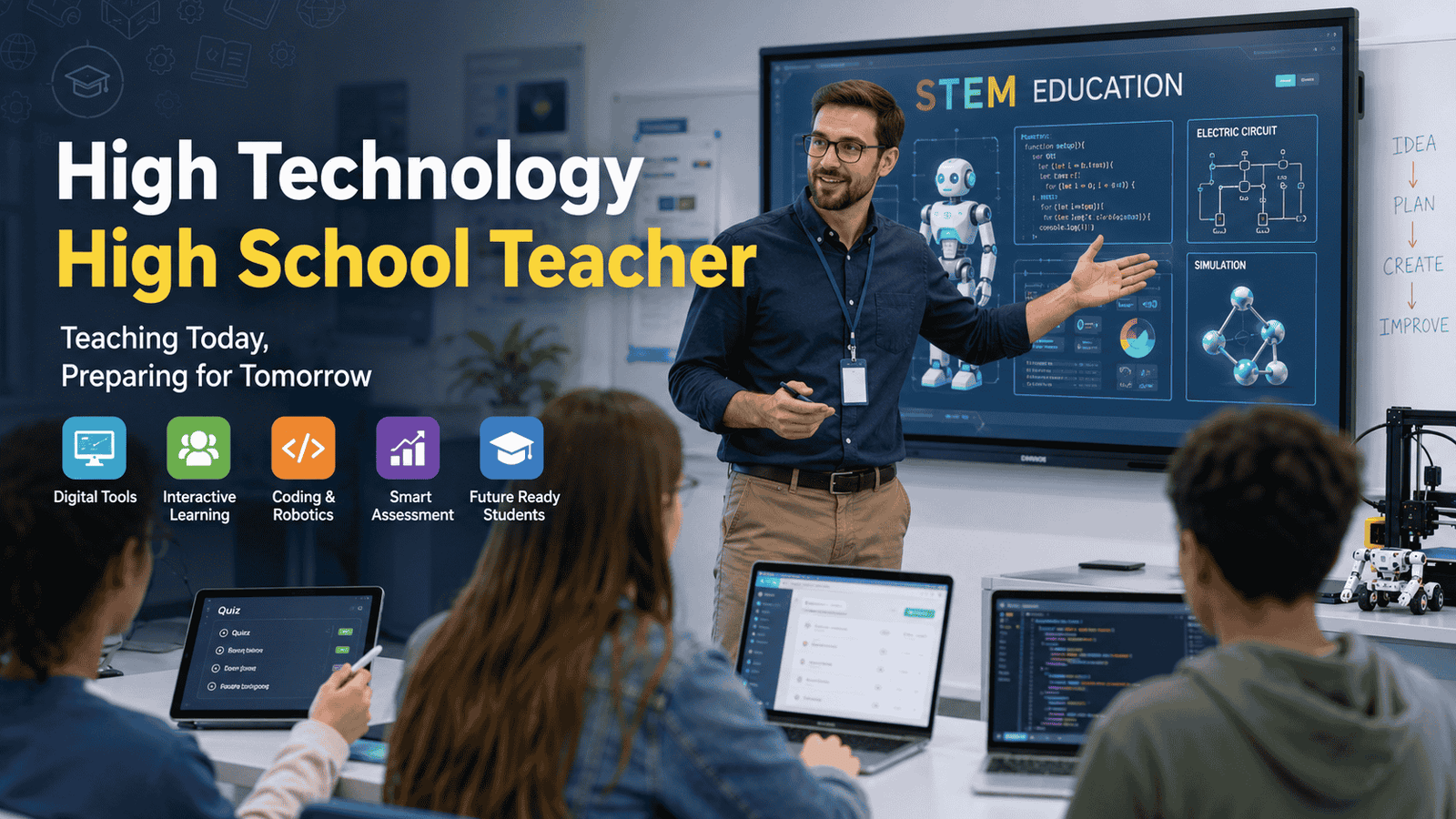
The role of a high technology high school teacher has changed a lot in recent years.
It’s not just about writing on a whiteboard anymore. Not even close.
Today, teachers in high-tech high schools work with digital tools, smart classrooms, coding platforms, online assessments, and sometimes even robotics labs. It’s a very different environment compared to traditional teaching.
And honestly, it can feel a bit overwhelming at first. Both for students and teachers.
But once you understand it, it actually becomes quite exciting.
In this article, we’ll break down what a high technology high school teacher does, what skills are needed, how classrooms are changing, and why this role is becoming more important every year.
What Is a High Technology High School Teacher?
A high technology high school teacher is an educator who teaches students using advanced digital tools, modern teaching systems, and technology-based learning methods.
They don’t just rely on textbooks.
Instead, they use:
- Smart boards
- Laptops and tablets
- Learning management systems
- Educational apps
- Online simulations
- Coding platforms
- Virtual labs
So the classroom feels more interactive and less traditional.
But at the core, the goal is still the same:
Help students learn and understand concepts clearly.
Why Technology Is Important in High Schools Today
Technology is now part of almost every job and industry.
So schools are adapting.
Students today need more than just memorization skills. They need:
- Problem-solving ability
- Digital literacy
- Communication skills
- Technical understanding
- Creativity with tools
A technology-driven classroom helps build all of this.
And that’s where high technology high school teachers come in.
Key Responsibilities of a High Technology High School Teacher
The job is more than just teaching.
Here are the main responsibilities:
1. Teaching with digital tools
Using apps, software, and online platforms to explain lessons.
2. Creating interactive lessons
Instead of lectures only, teachers design activities like:
- Online quizzes
- Virtual experiments
- Group digital projects
3. Managing classroom technology
Making sure devices, systems, and platforms work properly.
4. Tracking student progress digitally
Using tools to monitor:
- Attendance
- Assignments
- Test scores
- Participation
5. Supporting student digital skills
Helping students learn how to use technology safely and effectively.
Skills Required to Become a High Technology High School Teacher
This role requires a mix of teaching ability and technical knowledge.
1. Digital literacy
Understanding basic and advanced tools like:
- Google Classroom
- Microsoft Teams
- Educational software
2. Communication skills
Explaining technical concepts in simple language.
3. Adaptability
Technology changes quickly. Teachers must keep up.
4. Classroom management
Even with technology, managing student behavior is still important.
5. Problem-solving
Sometimes systems fail. Teachers need quick solutions.
Tools Used in High Technology Classrooms
Modern classrooms rely heavily on digital tools.
Here’s a simple table:
| Tool Type | Example | Purpose |
|---|---|---|
| Smart boards | Interactive whiteboards | Visual teaching |
| Learning platforms | Google Classroom | Assignments & grading |
| Coding tools | Scratch, Python IDE | Programming education |
| Video tools | Zoom, Teams | Remote learning |
| Quiz apps | Kahoot, Quizizz | Interactive testing |
| Simulation software | Science labs online | Virtual experiments |
These tools make learning more engaging and flexible.
How a High Technology Classroom Works
Let’s break it down step-by-step.
1: Lesson planning
Teacher prepares digital lesson materials.
2: Classroom delivery
Instead of only speaking, the teacher uses:
- Slides
- Videos
- Interactive tools
3: Student participation
Students actively join activities using devices.
4: Assessment
Quizzes and assignments are done online.
5: Feedback
Teachers review results and give feedback digitally.
It’s a continuous loop of learning and improvement.
Benefits of High Technology Teaching
There are many advantages.
1. Better student engagement
Students pay more attention when learning is interactive.
2. Easier understanding
Visual tools make complex topics simpler.
3. Faster feedback
Teachers can quickly check student performance.
4. Flexible learning
Students can learn at their own pace sometimes.
5. Real-world skills
Students learn technology skills they will actually use later.
Challenges Faced by High Technology High School Teachers
It’s not all easy.
There are challenges too.
1. Technical issues
Internet or device problems can disrupt lessons.
2. Training requirements
Teachers must constantly learn new tools.
3. Student distractions
Technology can sometimes lead to off-task behavior.
4. Budget limitations
Not all schools can afford advanced tools.
5. Workload increase
Digital systems can sometimes increase administrative work.
Traditional Teacher vs High Technology Teacher
Here’s a simple comparison:
| Feature | Traditional Teacher | High Technology Teacher |
| Teaching method | Lectures | Interactive digital tools |
| Resources | Books, chalkboard | Apps, software, devices |
| Student engagement | Moderate | High |
| Assessment | Paper exams | Online quizzes |
| Flexibility | Limited | High |
| Skills needed | Teaching only | Teaching + tech skills |
Both roles are important, but they work differently.
How Teachers Can Become Tech-Savvy Educators
If someone wants to become a high technology high school teacher, here are some steps:
1: Learn basic digital tools
Start with:
- Google Docs
- Classroom platforms
- Presentation tools
2: Use educational apps
Try tools like:
- Kahoot
- Quizizz
- Nearpod
3: Practice online teaching
Even recording small lessons helps.
4: Join training programs
Many schools offer digital teaching workshops.
5: Keep learning
Technology keeps changing, so learning never stops.
Future of High Technology High School Teaching
This field is growing fast.
In the future, we may see:
AI-assisted learning
Teachers supported by artificial intelligence tools.
Virtual classrooms
Students attending classes in VR environments.
Personalized learning systems
Each student gets customized lessons.
Automated grading
Less manual checking, more digital evaluation.
The role of teachers will evolve, not disappear.
Real Impact on Students
Technology in classrooms is not just about gadgets.
It actually changes how students learn.
Students become:
- More independent
- More creative
- More tech-skilled
- Better prepared for jobs
And that’s the real goal.
FAQs
What is a high technology high school teacher?
It is a teacher who uses modern digital tools and technology-based methods to teach high school students.
What skills do they need?
They need teaching skills, digital literacy, communication ability, and adaptability.
Is technology replacing teachers?
No. Technology supports teachers, it does not replace them.
What tools do they use?
They use smart boards, learning platforms, apps, coding tools, and online assessment systems.
Is this job difficult?
It can be challenging at first, but it becomes easier with training and practice.
Conclusion
A high technology high school teacher plays a very important role in modern education.
They are not just teaching subjects. They are also preparing students for a digital future.
Yes, the job requires extra skills and constant learning. And yes, it can sometimes be challenging.
But at the same time, it’s also one of the most dynamic and future-ready teaching roles today.
Because education is changing… and teachers are changing with it.
And honestly, that’s a good thing.
