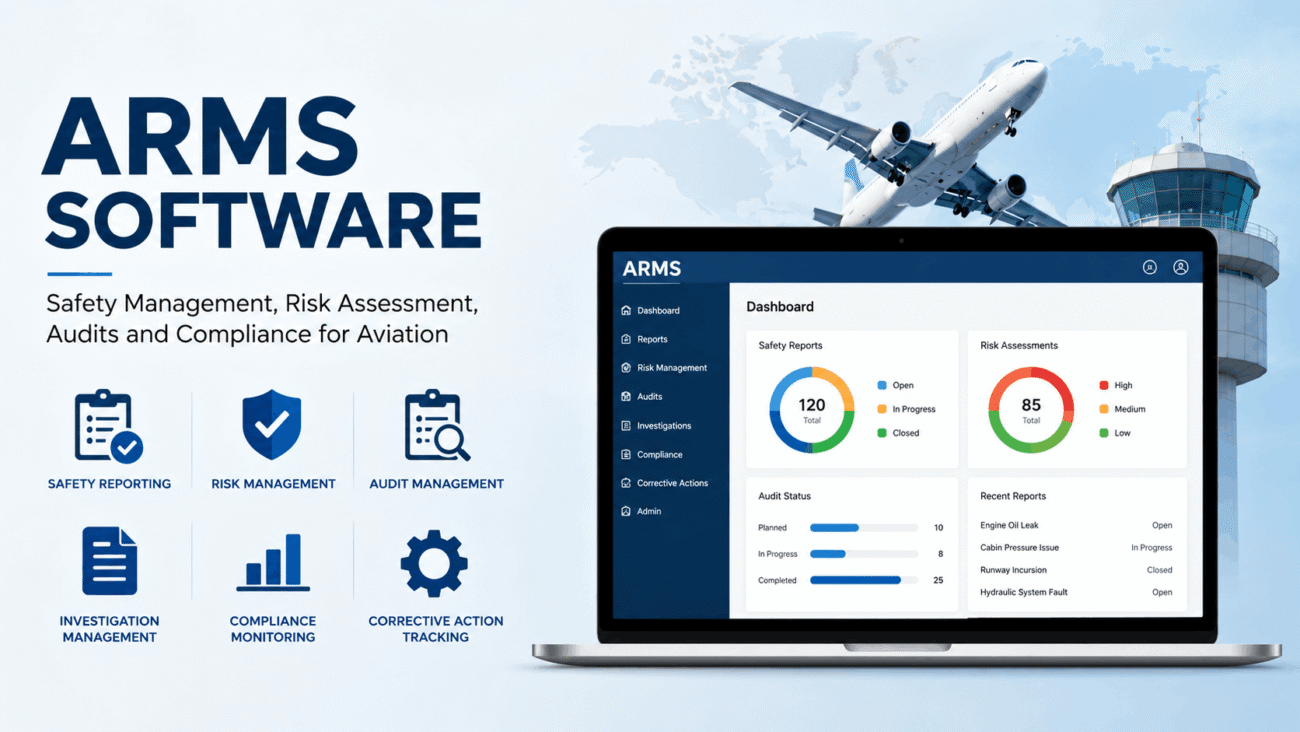
If you’ve searched for ARMS software, you’ve probably noticed that the term can refer to different systems depending on the industry. Some organizations use ARMS software for aviation safety and risk management, while others use software with the ARMS name for reporting, compliance, records management, or operational workflows.
One of the most recognized uses of the term is within the aviation industry, where ARMS software helps airlines, airports, and aviation organizations manage safety reporting, audits, risk assessments, investigations, and compliance activities. Users often search for topics like ARMS software login, ARMS software questionnaires, or ARMS software aviation when trying to understand how the platform works.
This guide explains what ARMS software is, how it supports aviation safety management, its key features, practical benefits, and important factors to consider before adopting a safety and compliance solution.
What Is ARMS Software?
ARMS software is a specialized management platform designed to help organizations collect, organize, and analyze operational information. Although software carrying the ARMS name may serve different industries, one of its best-known applications is aviation safety management.
In aviation, ARMS software supports Safety Management Systems (SMS) by providing tools that help organizations document incidents, assess risks, conduct audits, monitor corrective actions, and maintain regulatory compliance.
Instead of storing information across spreadsheets, emails, and paper documents, organizations can manage safety-related activities through a centralized digital platform.
Why Aviation Organizations Use ARMS Software
The aviation industry operates under strict safety and regulatory requirements.
Airlines, airports, maintenance providers, and flight operations teams must document incidents, investigate hazards, and demonstrate compliance with aviation regulations.
Managing this information manually can become difficult as organizations grow.
ARMS software simplifies these processes by helping teams:
- Report safety events
- Track investigations
- Perform risk assessments
- Schedule audits
- Monitor corrective actions
- Generate compliance reports
Having all this information in one system improves visibility and helps organizations respond more effectively to operational risks.
How ARMS Software Works
Although implementations vary between organizations, the general workflow follows a similar pattern.
Employees submit reports through the system whenever an incident, hazard, or operational concern occurs.
Managers then review the report, assign investigators if necessary, evaluate risks, document findings, and monitor corrective actions until the issue is resolved.
Throughout the process, the software maintains a complete record that can later be used for audits, internal reviews, or regulatory inspections.
This structured workflow helps ensure that important safety issues are not overlooked.
Core Features of ARMS Software
Modern safety management platforms typically combine several tools within a single environment.
Safety Reporting
One of the platform’s primary functions is collecting safety reports from employees.
Reports may include:
- Operational incidents
- Safety hazards
- Near misses
- Equipment issues
- Human factor observations
- Compliance concerns
Providing a simple reporting process encourages employees to report issues promptly.
Risk Management
Every reported event carries a different level of risk.
ARMS software helps organizations evaluate:
- Likelihood
- Severity
- Overall risk level
- Required mitigation measures
This structured approach helps decision-makers prioritize the most significant risks first.
Audit Management
Organizations frequently conduct internal and external audits.
The software supports audit planning by allowing teams to:
- Schedule inspections
- Assign responsibilities
- Track findings
- Document corrective actions
- Monitor completion
This creates a clear record of compliance activities over time.
Investigation Management
When incidents occur, investigations often involve multiple departments.
ARMS software helps organize investigation records by documenting:
- Event details
- Contributing factors
- Evidence
- Root cause analysis
- Recommended improvements
Maintaining complete documentation supports transparency and continuous improvement.
Compliance Monitoring
Regulatory compliance is a major responsibility within aviation.
The software allows organizations to monitor regulatory requirements while documenting actions taken to maintain compliance.
This organized approach makes preparing for inspections more efficient.
ARMS Software Aviation Applications
The aviation industry remains one of the most recognized users of ARMS software.
Organizations commonly include:
- Commercial airlines
- Private aviation companies
- Airport operators
- Aircraft maintenance organizations
- Flight training schools
- Government aviation agencies
- Helicopter operators
- Aviation service providers
Each organization has different operational requirements, but all benefit from structured safety management processes.
ARMS Software Questionnaires
Many users search for ARMS software questionnaires because questionnaires play an important role in collecting standardized operational information.
Organizations may use questionnaires for:
- Safety assessments
- Internal audits
- Compliance evaluations
- Employee feedback
- Operational reviews
- Risk identification
- Training assessments
Standardized questionnaires improve consistency by ensuring the same information is collected across departments and locations.
For example, during a routine safety inspection, inspectors may complete digital questionnaires that automatically generate reports and identify outstanding issues requiring follow-up.
ARMS Software Login
Another common search relates to the ARMS software login process.
Most enterprise software platforms require secure authentication before users can access organizational data.
Depending on the organization’s configuration, login options may include:
- Username and password
- Single Sign-On (SSO)
- Multi-factor authentication
- Corporate identity management systems
Because login procedures vary by organization, employees should follow their company’s internal IT policies and use official access portals provided by their employer.
Benefits of ARMS Software
Organizations adopt safety management software for several practical reasons.
Centralized Information
Instead of storing documents in multiple locations, reports, investigations, audits, and corrective actions remain organized within a single system.
This improves collaboration across departments.
Improved Regulatory Compliance
Maintaining organized documentation makes responding to inspections and demonstrating compliance significantly easier.
Historical records are also easier to retrieve when needed.
Better Risk Visibility
Managers can identify recurring issues by reviewing trends across multiple reports.
Recognizing patterns early allows organizations to implement preventive measures before larger problems develop.
More Efficient Investigations
Digital workflows simplify assigning investigators, tracking progress, documenting findings, and verifying that corrective actions have been completed.
Real-World Example
Imagine an airline where several maintenance technicians report similar equipment issues over a two-month period.
Without centralized reporting, each issue might appear unrelated.
Using ARM software, safety managers recognize the pattern through reporting dashboards, launch an investigation, perform a risk assessment, and recommend maintenance process improvements before the issue affects flight operations.
This proactive approach demonstrates how organized safety data supports better operational decision-making.
Comparing Manual Safety Management With ARMS Software
| Process | Manual Management | ARMS Software |
|---|---|---|
| Safety Reporting | Paper forms or emails | Centralized digital reporting |
| Risk Assessments | Individual spreadsheets | Integrated workflows |
| Audit Tracking | Separate documents | Unified dashboard |
| Corrective Actions | Manual follow-up | Automated tracking |
| Investigation Records | Multiple files | Centralized documentation |
| Compliance Reporting | Time-consuming | Streamlined reporting |
As organizations become larger and more complex, centralized software often improves consistency and efficiency compared to manual processes.
Pros and Cons of ARMS Software
Like any enterprise software platform, ARMS software offers significant benefits but also requires planning and commitment for successful implementation.
Pros
- Centralizes safety and compliance information.
- Improves incident reporting workflows.
- Supports structured risk assessments.
- Simplifies audit management.
- Tracks corrective actions efficiently.
- Helps organizations maintain regulatory documentation.
- Provides reporting tools for continuous improvement.
Cons
- Initial implementation may require planning and staff training.
- Enterprise software can involve a learning curve.
- Customization may require technical support.
- Smaller organizations may not need every available feature.
- Successful adoption depends on consistent employee participation.
The value of the platform often depends on how well it fits an organization’s operational processes and compliance requirements.
Common Mistakes Organizations Make
Even a well-designed safety management platform can be underused if proper practices are not followed.
Treating the Software as a Reporting Tool Only
Some organizations use ARM software only to record incidents.
The greatest value comes from analyzing trends, managing corrective actions, and continuously improving safety processes.
Delaying Incident Reporting
Waiting several days to document an event can reduce the accuracy of investigations.
Encouraging prompt reporting helps preserve important details while improving response times.
Incomplete Data Entry
Reports with missing information often slow investigations and make trend analysis less reliable.
Organizations should establish clear reporting standards so employees know what information should be included.
Ignoring Employee Training
Employees are more likely to use the software correctly when they understand both the system and the organization’s reporting expectations.
Regular training also reinforces the importance of safety reporting.
Expert Tips for Successful Implementation
Whether you’re introducing ARMS software for the first time or improving an existing deployment, these recommendations can help maximize its value.
Encourage a Strong Reporting Culture
Employees should feel comfortable reporting hazards, near misses, and operational concerns without fear of unnecessary criticism.
A healthy reporting culture improves both data quality and overall safety.
Standardize Workflows
Creating consistent procedures for reporting, investigations, and corrective actions improves efficiency across departments.
Standardized workflows also make regulatory audits easier.
Review Trends Regularly
Don’t wait for annual reviews.
Monthly or quarterly analysis of incident trends can identify recurring risks before they become larger operational problems.
Keep User Permissions Organized
Not every employee requires the same level of system access.
Assigning appropriate user roles helps protect sensitive information while ensuring employees can complete their responsibilities efficiently.
Integrate Safety Into Daily Operations
Safety software should support everyday decision-making rather than becoming a system employees only use after an incident occurs.
Regular engagement improves both software adoption and operational awareness.
Is ARMS Software Right for Your Organization?
Organizations that operate in highly regulated environments often benefit the most from structured safety management systems.
ARMS software may be a good fit for organizations that need to:
- Manage incident reports.
- Perform risk assessments.
- Conduct audits.
- Monitor corrective actions.
- Maintain compliance documentation.
- Analyze operational trends.
- Improve organizational safety culture.
Before selecting any enterprise safety platform, evaluate your operational requirements, regulatory obligations, integration needs, and long-term business objectives.
FAQs
What is ARMS software?
ARMS software is a management platform commonly used for safety, compliance, reporting, audits, investigations, and risk management. It is especially recognized within the aviation industry for supporting Safety Management Systems (SMS).
What is ARMS software aviation?
In aviation, ARMS software helps airlines, airports, maintenance organizations, and other aviation businesses manage safety reports, risk assessments, audits, investigations, corrective actions, and regulatory compliance.
What are ARMS software questionnaires?
ARMS software questionnaires are structured digital forms used to collect consistent information during audits, inspections, safety assessments, compliance reviews, employee feedback, and operational evaluations.
How does ARMS software login work?
Most organizations provide secure login access through company-issued credentials, Single Sign-On (SSO), or multi-factor authentication. The exact login process depends on the organization’s IT policies and software configuration.
Who benefits most from ARMS software?
Organizations operating in regulated industries—particularly aviation—benefit from ARMS software because it centralizes reporting, supports compliance, improves investigations, and strengthens overall safety management.
Conclusion
ARMS software plays an important role in helping organizations manage safety, compliance, audits, investigations, and operational risks through a centralized digital platform. While the term “ARMS software” may refer to different solutions depending on the industry, its strongest association remains with aviation safety management.
Whether you’re researching ARMS software aviation, looking for information about ARMS software questionnaires, or trying to understand the ARMS software login process, the key benefit is the same: creating structured workflows that improve visibility, accountability, and continuous improvement.
Choosing the right safety management platform requires more than comparing feature lists. Organizations should consider regulatory requirements, ease of use, integration capabilities, employee adoption, and long-term scalability before making a decision. With thoughtful implementation and consistent use, ARMS software can become an essential part of a strong operational safety program.
