There is a quiet shift happening in the Shopify ecosystem. A few years ago, support tools could survive as narrow utilities. One app handled chat. Another handled FAQs. Another captured emails. Another sent recovery emails. Another passed conversations to agents. The store owner assembled the stack and lived with the seams.
That model is getting weaker. Not because merchants suddenly love complexity less. They always hated it. It is weakening because the economics of ecommerce punish fragmentation more than most software categories do. Every seam between tools creates delay, duplicated logic, broken attribution, and a subtle loss of confidence inside the buying journey. The customer does not care which vendor owns which feature. They only feel whether the store seems coherent.
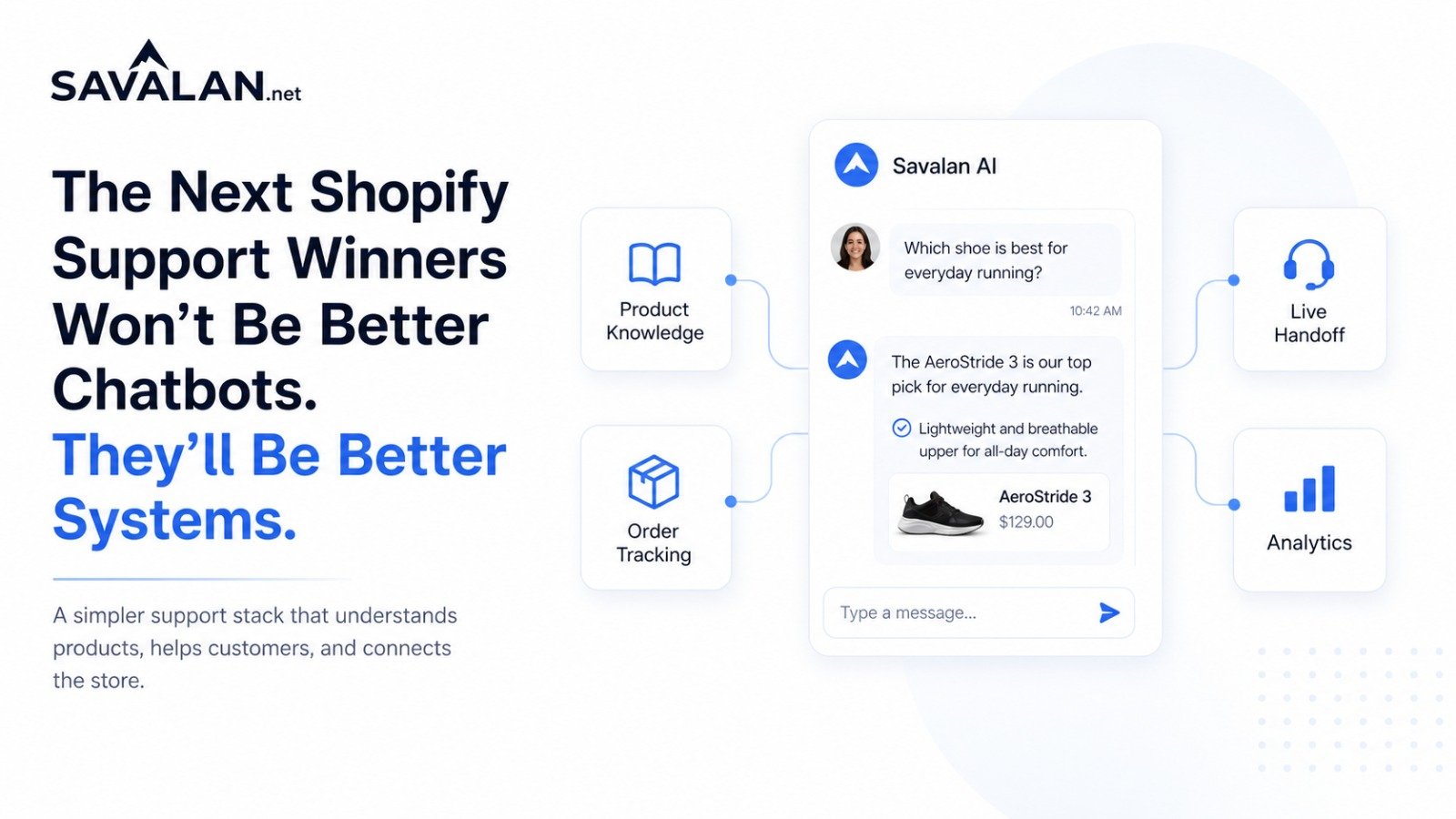
That is why the next winners in Shopify support will not be the tools with the loudest AI claims. They will be the ones that behave like systems.
The old way of evaluating support software was feature-by-feature. Does it answer questions? Does it hand off to a human? Does it recover abandoned carts? Does it track conversations? That checklist still matters, but it no longer gets to the heart of the problem. The real question is whether those functions operate from the same commercial reality.
A store does not need a bot that merely talks. It needs a layer that understands products, recognizes hesitation, knows when certainty is missing, and routes the moment correctly. That is a much harder standard than “has AI.”
This distinction matters because most Shopify support friction is not really support friction. It is pre-purchase uncertainty wearing a support costume. A shopper asks whether two items are compatible, whether a size runs small, whether a bundle makes sense, whether shipping timing is reliable, whether a return will be painful if the product disappoints. These are not low-value interruptions. They are conversion events in disguise.
Tools fail when they treat those moments as tickets to close instead of decisions to support.
That is where a serious AI customer service layer starts to look different from a generic chatbot. The useful systems are not impressive because they can produce fluent paragraphs. They are useful because they can stay close to the commercial facts of the store: catalog structure, policy constraints, inventory reality, order context, and the threshold where a human should step in. When that foundation is missing, the interface can still feel smooth while the economics underneath get worse.
This is the uncomfortable truth in the category. A great-looking conversation can still be a bad store experience. In ecommerce, wrong-but-confident is often worse than brief-but-accurate. The merchant pays for that in abandoned carts, unnecessary discounting, and customer distrust that rarely shows up cleanly in a dashboard.
The second shift is that integration quality is starting to matter more than standalone intelligence. The best support tools are no longer judged only by what they say in the chat box. They are judged by how deeply they sit in store operations. Can they pull product context cleanly? Can they reflect catalog changes without lag? Can they pass conversation state to a human without forcing the customer to repeat everything? Can they attach support behavior to revenue outcomes instead of vanity metrics?
That is why the phrase Shopify integration should be read more carefully than it usually is. For many merchants, integration still means a widget appears on the storefront and some data syncs eventually. But the strategic version of integration is different. It means the support layer is close enough to the store’s moving parts that it can reduce uncertainty without inventing certainty. That is a much rarer capability.
There is a trade-off here, and it is worth stating plainly. Deeper integration increases product value, but it also raises the implementation burden on the vendor. You cannot fake operational depth. If the catalog is messy, the workflows are inconsistent, or the handoff model is weak, a more powerful system will expose those cracks faster. In that sense, better support software is unforgiving. It does not merely decorate the business. It reveals whether the business is internally coherent.
That is one reason many support tools drift toward feature inflation. It is easier to launch another visible capability than to solve the hard internal problems of orchestration, retrieval quality, escalation logic, and attribution. The market rewards visible motion, even when the merchant would benefit more from invisible reliability.
But the market is also maturing. Merchants are getting better at asking the right questions. Not “Does this app have AI?” but “Does this reduce buying friction without increasing operational fragility?” Not “Can it answer customers automatically?” but “When the conversation becomes valuable, does the system get smarter or does it collapse?”
The third shift is more strategic: distribution is becoming part of the product.
That may sound like a founder concern rather than a merchant one, but in Shopify it affects both. The apps that survive long enough to compound tend to find efficient, trust-based acquisition channels. Paid traffic is expensive. App-store exposure is volatile. Cold outbound is rarely elegant in a category where trust and reliability matter. That leaves a narrower set of durable routes: ecosystem credibility, integrations, word of mouth, and well-designed partner channels.
A thoughtful partner program is not just a marketing add-on. In the best cases, it is a signal about how a product intends to spread: through practitioners who already understand store operations, already see the pain points firsthand, and already have reputational skin in the game. That kind of distribution is slower than brute-force acquisition, but often stronger. It selects for products that survive real scrutiny rather than products that simply interrupt enough buyers.
This matters because support software is entering a convergence phase. Chat, AI answers, handoff, analytics, recovery flows, lead capture, and recommendation logic are no longer cleanly separate categories. They are collapsing into a single operational layer around customer intent. Once that happens, the weak products get trapped in the middle. They are too broad to be best-in-class point solutions, but too shallow to become real systems.
The durable companies will probably look boring from a distance. They will be less obsessed with theatrical AI and more obsessed with whether the store becomes measurably easier to buy from. They will care about retrieval quality more than writing style, handoff design more than demo scripts, and revenue-linked measurement more than activity metrics. They will understand that in commerce, the most important support moment often happens before the customer thinks of themselves as needing support at all.
That is the deeper opportunity in Shopify support now. Not replacing humans. Not automating every conversation. Not adding another interface element to the store.
Building systems that remove uncertainty at the exact point where uncertainty kills demand.
The companies that understand that will not just win the chatbot category.
They will quietly outgrow it.
