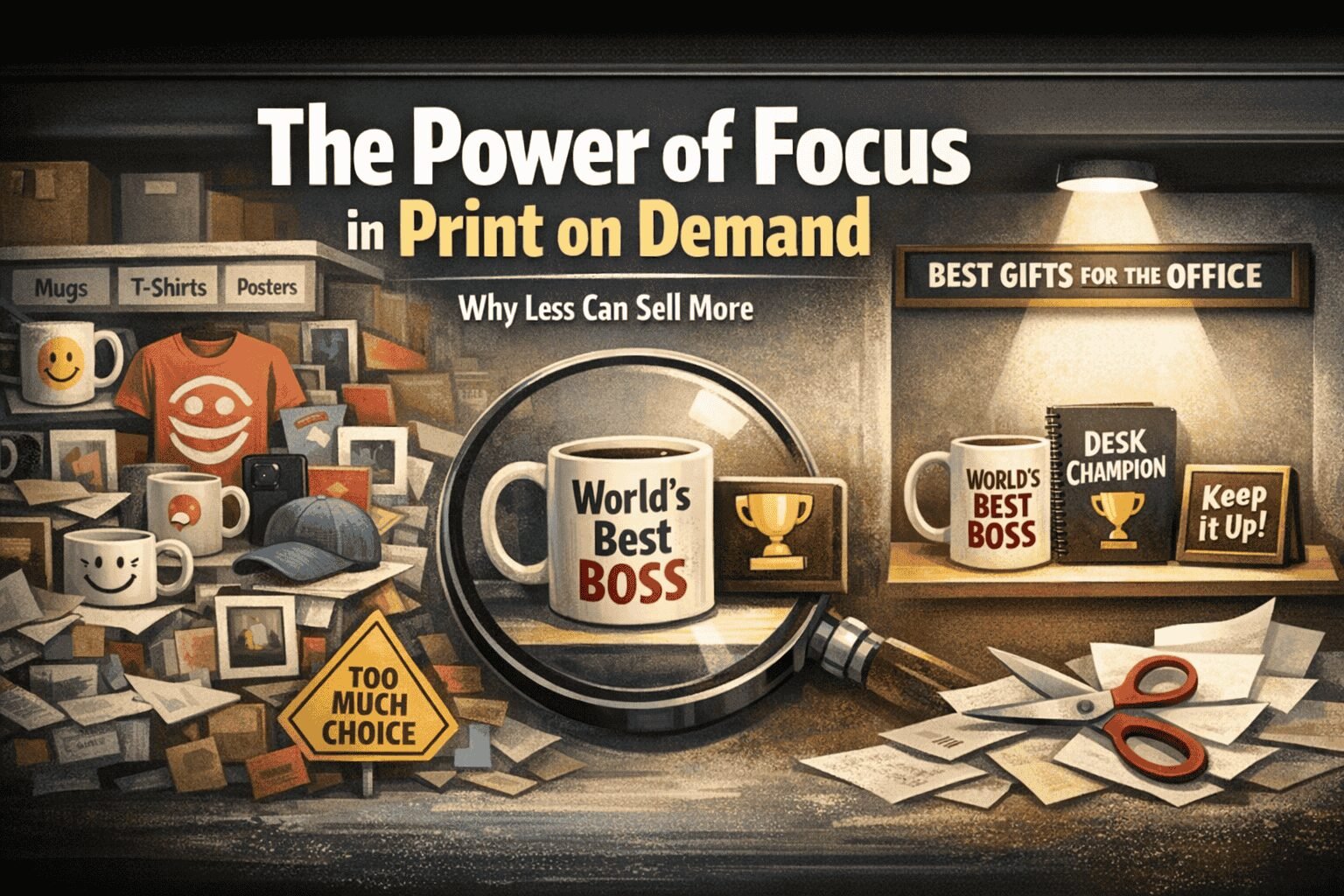
The default move in print on demand is expansion. Sales slow, so the seller adds more designs, more product types, more niches, more marketplaces. It feels rational because the marginal cost of adding a new listing is low. But low cost is not the same thing as low consequence. In practice, many POD stores do not stall because they lack inventory. They stall because they have turned the catalog into a cognitive tax.
That problem is easy to miss on large marketplaces. Platforms like Redbubble or Merch by Amazon absorb some of the friction. The shopper already trusts the checkout, already understands the product format, and often arrives with a narrow search intent. An independent store has to do more work. It has to answer a harder question: why this item, for this person, in this context, right now?
This is why the strongest POD shops usually feel narrower than the average seller expects. They are not trying to express every design on every printable surface. They are making a smaller number of buying decisions easier. A customer rarely wakes up wanting print on demand. They want a funny mug for an office gift, a piece of wall art that fits a room, a shirt that says something about identity without looking cheap. The store that organizes around those moments has an advantage over the store that organizes around its own production possibilities.
The discipline shows up first in category design. Many sellers treat categories as filing cabinets. Mugs go in one box, posters in another, apparel somewhere else. That makes sense from the operator’s side, but it is often weak from the buyer’s side. Buyers think in use cases. They compare gifts, not SKUs. They compare décor styles, not printing methods. When a catalog is built only around product type, the customer has to do the merchandising mentally.
A better approach is to decide which categories deserve to be hero categories and which ones should remain supporting pieces. Most stores only have the attention to make one or two categories truly persuasive. That means better photography, sharper copy, tighter assortments, and clearer price logic in those categories. The rest can exist, but they should not dilute the point of the store.
If you study a focused personalized mug collection or a carefully edited custom tshirt art category, the useful lesson is not that mugs or tshirt art are universally superior. It is that the category feels intentional. The shopper can understand what belongs there, why it belongs there, and who it is for. That reduces friction more effectively than adding twenty more mediocre listings.
The same principle applies to design reuse. POD makes it dangerously easy to place one graphic on ten blank products and call it a collection. Sometimes that works. Often it does not. Each product asks the customer to solve a different problem. A mug is often bought as a compact, low-risk gift. A piece of wall art is a room decision. A t-shirt is a self-presentation decision. When sellers ignore those differences, they mistake production efficiency for merchandising intelligence.
A useful test is this: if the design disappeared and only the category structure remained, would the store still feel coherent? Strong stores can survive that test. Weak ones cannot. Their sales depend on isolated hits rather than a system that helps customers browse, compare, and commit.
Trust is the second hidden constraint. Many sellers treat trust as a branding exercise when it is really a decision-making aid. Customers want signals that reduce regret: consistent mockups, believable product context, size information that answers real questions, and copy that sounds like a human being has handled the product logic before. Even a small print-on-demand home and gift store becomes easier to buy from when the assortment looks curated rather than merely available.
This is one reason why more products can quietly lower conversion. Every weak listing sets a reference point for the rest of the store. One generic mockup can make five better products look less trustworthy. One confused category can make the catalog feel random. In retail, the bad item does not sit alone; it contaminates the perceived quality of its neighbors.
The strategic mistake, then, is not simply overproduction. It is failing to choose what business you are actually in. Are you a design archive, a gift shop, a home décor brand, a fandom catalog, a workplace humor store? The answer shapes everything from category names to bundling logic to which products deserve real attention. Without that choice, a POD shop drifts into a pile of printable objects.
For sellers on marketplaces, the implication is simple: think beyond upload volume. The listing is not the whole business. The real edge is the ability to develop repeatable merchandising judgment. Notice which designs deserve extension and which should stay isolated. Notice where customers hesitate. Notice whether your best-sellers cluster around an occasion, a room, or a type of buyer. Those patterns are usually more important than raw trend chasing.
For sellers running their own stores, the bar is higher but so is the upside. The store can become more than a place where products happen to exist. It can become a decision engine. That requires subtraction before addition. Trim weak products. Collapse redundant categories. Strengthen the one or two areas where the store can plausibly feel like an authority. In print on demand, restraint is not aesthetic modesty. It is commercial clarity.
The temptation in this business will always be to add. The better move, surprisingly often, is to edit. The stores that hold together over time are usually not the ones with the biggest catalogs. They are the ones that make buying feel obvious.
