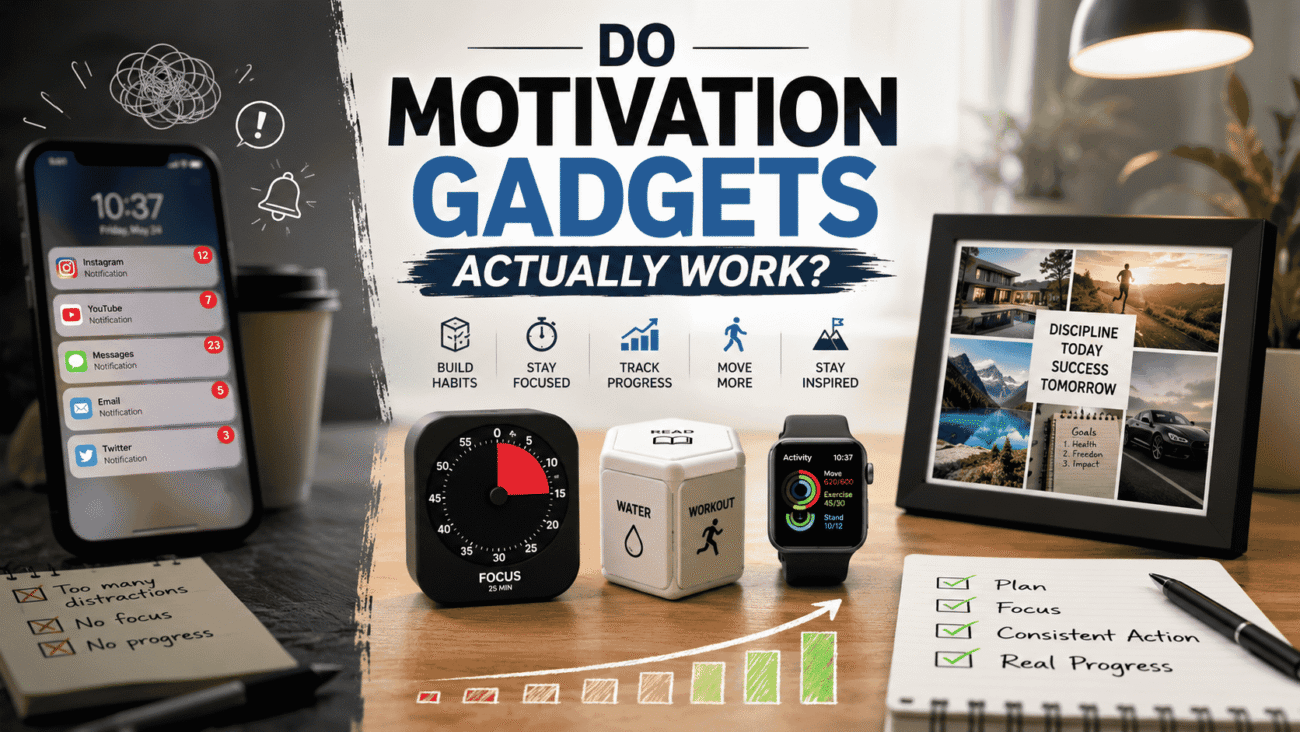
I’ll admit it: the first motivation gadgets I ever bought sat in its box for three weeks before I even opened it. That’s a little embarrassing to confess in an article about motivation, but it’s also kind of the point. Buying the thing was never the hard part. Using it consistently was.
For years I rolled my eyes at anything marketed as a “motivation gadgets.” A cube that reminds you to breathe? A ring that buzzes when you’ve been sitting too long? It all sounded like stuff you’d impulse-buy at 2 a.m. after falling down a productivity-video rabbit hole on YouTube.
Then, somewhat reluctantly, I actually tried a handful of them. Over about two years, I ran them through real conditions — training for a half marathon I nearly quit twice, and grinding through a freelance project during a stretch of burnout that I wouldn’t wish on anyone. A few of these gadgets earned a permanent spot on my desk. Most didn’t survive the month.
This isn’t a copy-paste “top 10” list built from spec sheets and press releases. It’s what I actually learned from living with these tools day to day — where they genuinely help, and where the marketing runs way ahead of what the product can deliver.
What Counts as a “Motivation Gadget,” Really
People throw this term around pretty loosely, so let’s nail it down first. A motivation gadget, as I’m using it here, is a physical device — not an app, not a subscription buried three menus deep — built to nudge your behavior toward a goal. That’s a wider category than you’d think:
- Habit trackers and physical habit cubes
- Focus timers (the Pomodoro-style kind you can actually hold)
- Wearables tracking movement, sleep, or stress
- Desk gadgets that reward or interrupt behavior, like posture correctors
- Smart water bottles and hydration reminders
- Digital picture frames built around vision boards
Some of these succeed because they put a little friction between you and a bad habit. Others work because they make quiet progress suddenly visible. And the ones that flop? They usually do neither. They just become one more notification you’ve trained yourself to ignore.
Why Physical Gadgets Can Beat Apps (Sometimes)
I’m not anti-app, to be clear. I still use several. But there’s a genuine difference between a physical object sitting on your desk and a notification buried under forty other alerts on a phone you’ve already learned to tune out.
A gadget takes up real estate in your actual environment. You see it. You bump into it. You have to physically deal with it in some way. That difference matters more than people give it credit for — behavioral scientists sometimes call it “environmental design,” where your surroundings quietly do part of the self-control work instead of leaving it all to willpower, which, let’s be honest, is a pretty unreliable resource on a bad day.
That said, no gadget is magic, and I wish more of the marketing admitted that. If you’re expecting a device to fix a motivation problem rooted in something deeper — burnout, fuzzy goals, a calendar that’s simply too full — it won’t. It’s a tool. Not a therapist, not a life coach, not a shortcut around the harder work.
The Gadgets I Actually Tested
1. Habit-Tracking Cubes
These little cubes let you flip a side to log a habit — water intake, reading, meditation, whatever you assign to each face. No app, no charging cable, no account to set up at 11 p.m. while half asleep.
I used one during a month when I was trying to stop checking email the second I woke up. Flipping the cube each morning, but only after doing something else first — coffee, a short walk around the block — worked better than I expected going in. Honestly, I don’t think the cube itself deserves the credit. It was the two-second pause before flipping it that mattered, the tiny beat where I actually noticed the choice I was making instead of sleepwalking through it.
Where it falls apart: if you’re tracking more than four or five habits, the cube format gets clunky fast. It’s built for simplicity, not for running your entire habit stack.
2. Pomodoro Focus Timers
Physical timers — the kind with an actual dial, not the app version buried on your lock screen — turned out to be one of the more reliable tools I tested, and I was genuinely surprised by that. There’s something about a visible, ticking countdown that a phone timer just can’t replicate, mostly because the phone is also the thing distracting you in the first place.
I leaned on a basic mechanical timer during a stretch of deep writing work. Setting it for twenty-five minutes and physically putting my phone in another room cut my “getting started” resistance more than any focus app I’ve tried, blockers included. There’s no algorithm here. It’s just friction, and friction works.
3. Fitness and Sleep Wearables
This category is enormous, and honestly, its motivational value swings wildly from person to person. For me, seeing a sleep score first thing in the morning changed my bedtime habits faster than any article on sleep hygiene ever managed to. Numbers made it real in a way advice never quite does.
But I’ve talked to plenty of people who found the constant metrics stressful rather than motivating. Checking scores became its own little anxiety loop for them. If you already have a tendency to over-monitor yourself, a wearable might work against you here, not for you — worth thinking about honestly before you buy one.
4. Posture and Movement Reminders
These are small clip-on devices that buzz when you slouch or sit too long. Useful, sure, but the honeymoon period is short — shorter than I expected, actually. Within two weeks I’d started ignoring the buzz the same way you tune out a car alarm going off three streets over. It still has some value as an occasional reset, just not as a standalone long-term fix.
5. Digital Vision Board Frames
These display rotating images of whatever you’re working toward — a house, a race finish line, a number on a scale, whatever matters to you. I went in skeptical, expecting it to feel gimmicky. It ended up being more effective than I predicted, mainly because it just existed in my peripheral vision without asking anything of me. No app to open. No habit to build or maintain. It was simply there, doing its quiet thing.
The catch is that the effect fades if the images never change. Staring at the same three photos for six months eventually stops registering as anything at all.
Comparison Table: Motivation Gadgets at a Glance
| Gadget Type | Best For | Setup Effort | Long-Term Stickiness |
|---|---|---|---|
| Habit cube | Simple daily habits (1-6) | Very low | High if habits stay few |
| Physical Pomodoro timer | Deep focus, writing, studying | Low | High |
| Fitness/sleep wearable | Data-driven motivation | Medium | Varies by personality |
| Posture reminder clip | Short-term awareness | Low | Low without variation |
| Vision board frame | Passive, long-term goals | Medium (photo curation) | Medium, needs refreshing |
Common Mistakes People Make With Motivation Gadgets
Buying more than one at a time. I made this exact mistake early on. Three gadgets showed up in the same week, and I’d abandoned all three within a month. Introducing one habit-support tool at a time gives you an honest read on whether it’s actually helping or just novel.
Expecting the gadget to hand you a reason. A timer won’t give you a reason to write. It just clears away some of the friction once you’ve already got one.
Underestimating the annoyance curve. Nearly every gadget with alerts or buzzes fades into background noise after a couple of weeks. If a device only works because it’s new, it hasn’t actually solved your underlying motivation problem — it’s just distracted you from it for a while.
Skipping the trial period. Give any gadget at least two honest weeks before deciding whether it’s a keeper. First-week enthusiasm lies to you. Everything feels motivating when it’s shiny and new.
Expert Tips for Choosing the Right One
- Match the gadget to your actual friction point. Struggling to start tasks? A timer helps. Forgetting habits entirely? A cube or wearable is the better fit.
- Favor tools with a manual, low-tech option. Devices that demand an app, an account, and constant syncing often add more friction than they remove — which kind of defeats the purpose.
- Set a two-week trial before you buy in emotionally. Decide ahead of time what “working” actually looks like, so you’re not just going off mood.
- Refresh passive tools regularly. Vision boards and desk reminders lose their punch through sheer repetition. Update them monthly if that’s your category.
- Don’t shop purely by review score. Motivation is deeply personal, and a gadget that transformed someone else’s routine might do absolutely nothing for yours. That’s not a failure on your part — it’s just fit.
Pros and Cons of Motivation Gadgets Overall
Pros:
- Physical presence creates genuine environmental cues
- Many require no ongoing subscription
- Low learning curve compared to complicated apps
- Can complement, rather than replace, habits you already have
Cons:
- Novelty wears off faster than the marketing ever admits
- Some create stress instead of relief, especially the data-heavy wearables
- Doesn’t touch root causes like burnout or unclear goals
- Quality varies wildly between brands, and the cheap ones often die within months
A Realistic Way to Think About These Tools
None of these gadgets fixed my motivation single-handedly, and I’d be lying if I said otherwise. What they actually did was shave off small pieces of friction — one less decision here, one visible reminder there. Over the course of weeks, those small removals quietly added up to real behavior change.
If you’re hoping a gadget will manufacture reasons for doing something you don’t actually care about, you’re going to be disappointed. But if you’re using one to support a goal that already matters to you, it can genuinely help — I’ve seen it happen in my own routine more than once.
FAQs
Do motivation gadgets actually work, or is it a placebo effect?
Honestly, probably both. Some of the effect comes from real friction reduction, and some comes from the psychological lift of investing in a tool tied to your goal. Either way, if the behavior change sticks, the exact mechanism matters a lot less than the result.
How much should I spend on a motivation gadgets?
Start cheap. A basic mechanical timer or a simple habit cube costs very little and tells you a lot about whether the format even suits you, before you drop real money on a pricier wearable.
Can motivation gadgets replace therapy or coaching for deeper motivation issues?
No, and I’d be doing you a disservice if I said otherwise. These are tools for behavior support, not treatment for burnout, depression, or deeper motivational blocks. If your lack of motivation feels persistent or tied to your mental health, talk to a professional before you go shopping for another gadget.
What’s the biggest reason people stop using motivation gadgets?
Novelty fade, hands down. Most people quietly abandon a gadget within a few weeks once the initial excitement wears off, especially if the device leans on alerts and buzzes instead of triggering a genuine shift in habit.
Are wearables better than simple gadgets like habit cubes?
Not necessarily, and this surprised me too. Wearables hand you more data, but data isn’t automatically motivating — for some people it’s flat-out overwhelming. Simpler, lower-tech gadgets often stick around longer specifically because they ask less of you.
Key Takeaways
So, do motivation gadgets work? Some do, some really don’t, and the difference almost always comes down to whether the device matches the actual friction point you’re dealing with. In my experience, physical timers and simple habit trackers tend to outlast the flashier wearables, mostly because they ask less of you and lean less on novelty to stay interesting.
Test one tool at a time. Give it two honest weeks. And don’t expect any motivation gadgets, no matter how clever, to substitute for a goal you actually care about. The device supports the habit — it doesn’t invent the motivation for you. That part’s still on you. Which, if you think about it, is actually good news, because it means your progress was never really riding on the next product launch.
