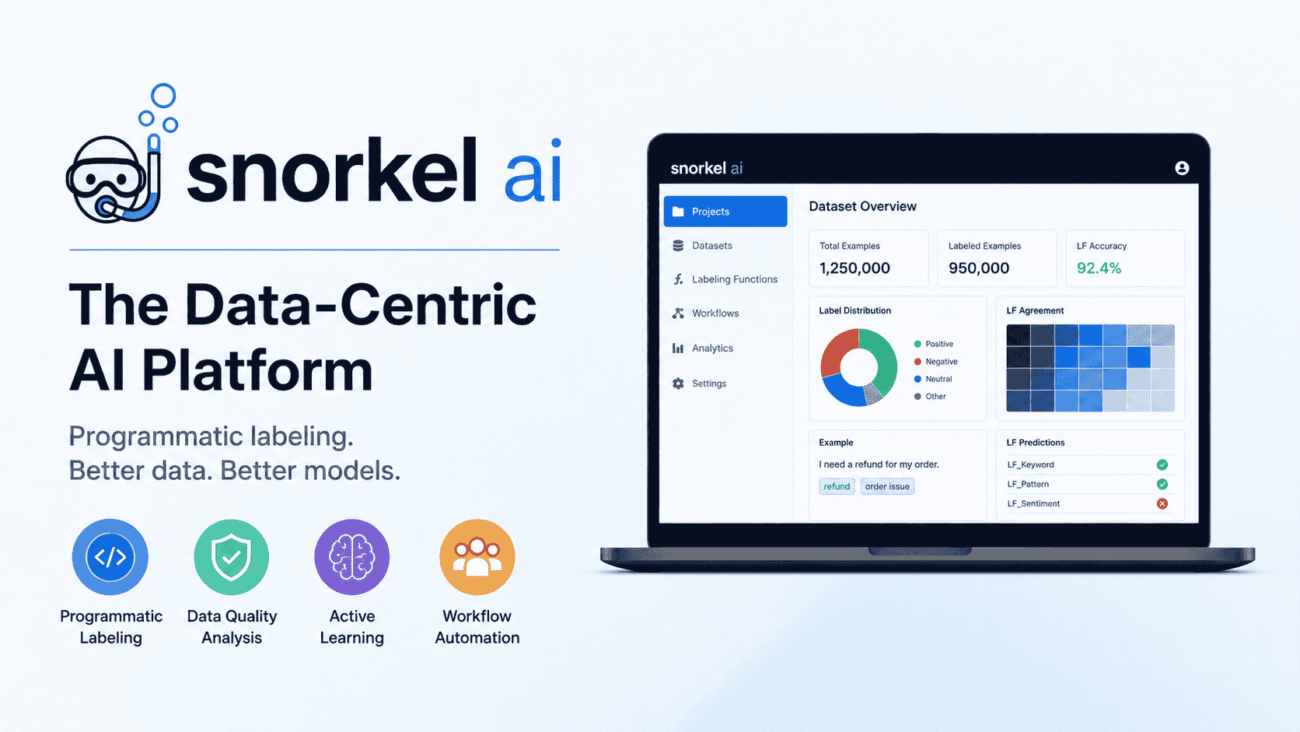
Building a successful artificial intelligence model usually starts with one challenge: finding enough high-quality labeled data. For many companies, manually labeling thousands or even millions of records is expensive, slow, and difficult to scale. That’s where Snorkel AI comes in.
Instead of relying entirely on manual annotation, Snorkel AI helps organizations create training datasets using programmatic labeling and data-centric AI techniques. The goal is to reduce the time spent labeling data while improving the quality of machine learning models.
Whether you’re researching the platform, looking for information about Snorkel AI careers, curious about Snorkel AI valuation, or searching for the Snorkel AI login page, this guide explains everything you need to know in clear, practical language.
What Is Snorkel AI?
Snorkel AI is an AI development platform designed to help organizations build, manage, and improve machine learning datasets more efficiently. Rather than manually labeling every data point, the platform allows teams to create labeling rules and workflows that automatically generate large training datasets.
The company focuses on what is often called data-centric AI, an approach that emphasizes improving the quality of training data instead of only refining machine learning algorithms.
This makes the platform particularly valuable for organizations working with:
- Natural language processing (NLP)
- Computer vision
- Document analysis
- Healthcare AI
- Financial services
- Legal technology
- Enterprise automation
Instead of spending months labeling data by hand, teams can automate much of the process while maintaining quality through testing and validation.
Why Data Labeling Is Such a Challenge
Machine learning models learn by studying examples.
If those examples are inaccurate, incomplete, or inconsistent, the resulting AI system will also perform poorly.
Traditional data labeling presents several challenges:
- It requires significant human effort.
- Large datasets take weeks or months to annotate.
- Human reviewers may disagree on labels.
- Costs increase as datasets grow.
- Updating labels becomes difficult over time.
These challenges often slow AI projects before model training even begins.
Snorkel AI was created to address many of these problems by making dataset creation faster and easier to manage.
How Snorkel AI Works
Instead of manually reviewing every record, users create labeling functions.
A labeling function is essentially a rule that tells the system how to identify certain patterns within the data.
For example, imagine building an AI model that identifies customer complaints.
Rather than reading thousands of support emails individually, a labeling function might recognize phrases such as:
- “Refund request”
- “Order never arrived”
- “Billing issue”
- “Damaged product”
The platform combines multiple labeling functions, evaluates their reliability, and generates training labels automatically.
This approach allows data scientists to produce large datasets much more quickly than traditional annotation methods.
Understanding Data-Centric AI
Many AI discussions focus on building better algorithms.
Data-centric AI takes a different approach.
Instead of constantly modifying machine learning models, it focuses on improving the quality of the training data those models learn from.
Imagine teaching two students.
One receives clear, accurate study materials.
The other studies outdated or incorrect information.
Even if both students have the same ability, the first student is more likely to succeed because the training material is better.
Machine learning works in much the same way.
Better data often produces better AI.
Key Features of Snorkel AI
Different organizations use the platform for different reasons, but several core features consistently stand out.
Programmatic Labeling
This is the platform’s signature capability.
Instead of assigning labels manually, users define rules that automatically classify data.
These rules can be updated whenever new information becomes available, making datasets easier to maintain.
Data Quality Analysis
Generating labels is only part of the process.
The platform also helps evaluate label quality, identify inconsistencies, and highlight areas where additional review may be necessary.
Improving dataset quality often leads to stronger machine learning performance.
Active Learning
Some records are easier for AI to classify than others.
Active learning identifies uncertain examples that would benefit most from human review.
Rather than reviewing every record equally, teams can focus their attention where it has the greatest impact.
Workflow Automation
Large AI projects often involve multiple people.
Workflow management features help organize labeling tasks, monitor progress, and coordinate collaboration between engineers, data scientists, and subject matter experts.
Integration with Machine Learning Pipelines
Modern AI development rarely happens inside one application.
Snorkel AI supports integration with broader machine learning workflows, allowing organizations to move data efficiently between labeling, training, evaluation, and deployment stages.
Real-World Applications of Snorkel AI
One reason the platform has gained attention is its flexibility across industries.
Healthcare
Medical organizations often analyze clinical documents, research papers, and patient records.
Programmatic labeling can help organize large volumes of healthcare data for machine learning while reducing repetitive manual work.
Financial Services
Banks and financial institutions use AI for fraud detection, document classification, compliance monitoring, and risk assessment.
High-quality labeled datasets improve the accuracy of these applications.
Legal Technology
Legal teams frequently process contracts, court filings, and regulatory documents.
Automated labeling helps organize large collections of legal text for AI analysis.
Customer Support
Businesses receive thousands of customer inquiries every day.
Machine learning models trained with well-labeled support conversations can automatically classify requests and route them to the correct department.
Manufacturing
Manufacturers use AI to inspect products, detect defects, and monitor production quality.
Computer vision models benefit from accurate image labeling during training.
Benefits of Using Snorkel AI
Organizations choose data-centric AI platforms for several practical reasons.
Faster Dataset Creation
Programmatic labeling dramatically reduces the amount of manual annotation required for large projects.
Instead of labeling millions of records individually, teams create reusable labeling rules.
Lower Long-Term Costs
Although AI development still requires skilled professionals, reducing repetitive manual work can lower ongoing dataset maintenance costs.
Better Model Performance
High-quality training data often leads to more accurate machine learning models.
Improving datasets may produce greater gains than repeatedly adjusting model architecture.
Easier Dataset Updates
Business rules change over time.
When using programmatic labeling, organizations can update labeling functions instead of manually relabeling every record.
This makes long-term maintenance much more manageable.
Snorkel AI Careers: Opportunities in a Growing Field
Interest in Snorkel AI careers has grown alongside the increasing demand for machine learning expertise.
The company has attracted professionals with backgrounds in artificial intelligence, software engineering, data science, product management, research, customer success, and enterprise solutions.
Like many technology companies focused on enterprise AI, roles may vary depending on business needs and ongoing product development.
Individuals interested in working with advanced machine learning systems often monitor career opportunities through the company’s official careers page, where current openings, qualifications, and application details are listed.
Beyond technical positions, organizations in this space also hire professionals in marketing, sales, operations, and business development to support continued growth.
Snorkel AI Valuation: Why Investors Have Taken Notice
Another topic that frequently appears in online searches is Snorkel AI valuation.
The company has attracted attention from investors because of its focus on enterprise AI and data-centric machine learning. As organizations continue investing in artificial intelligence, platforms that simplify dataset development have become increasingly valuable.
It’s important to remember that private company valuations can change over time as new funding rounds, market conditions, and business performance evolve.
For the most accurate and up-to-date valuation information, readers should consult recent company announcements or trusted financial reporting sources rather than relying on older estimates.
Understanding the Snorkel AI Login Process
If you’re searching for the Snorkel AI login, you’re likely trying to access the platform or manage your organization’s workspace.
In most enterprise software platforms, users receive login credentials through their organization or during the account setup process. After signing in, authorized users can typically access projects, datasets, labeling workflows, and collaboration tools based on their assigned permissions.
For security reasons, it’s always best to access the login page directly through the official Snorkel AI website rather than third-party links. This helps reduce the risk of phishing attacks and protects sensitive project data.
If you experience login issues, common troubleshooting steps include:
- Verify your email address and password.
- Reset your password if necessary.
- Check whether your organization uses single sign-on (SSO).
- Contact your administrator for account access.
- Review the platform’s support documentation for additional guidance.
How Snorkel AI Compares with Traditional Data Labeling
One of the easiest ways to understand Snorkel AI is to compare it with manual annotation workflows.
| Feature | Traditional Labeling | Snorkel AI |
|---|---|---|
| Label Creation | Manual annotation | Programmatic labeling |
| Speed | Slower for large datasets | Faster once labeling functions are created |
| Scalability | Limited by human resources | Designed for large enterprise datasets |
| Dataset Updates | Often requires relabeling | Rules can be updated and reused |
| Collaboration | Manual coordination | Integrated workflow management |
Neither approach is universally better. Small projects may still benefit from manual labeling, while large enterprise AI initiatives often gain significant efficiency from programmatic methods.
Common Mistakes Organizations Make
Adopting a data-centric AI platform is only part of building successful machine learning systems. Several common mistakes can reduce the effectiveness of even the best tools.
One mistake is assuming automation eliminates the need for human expertise. Labeling functions still require thoughtful design, testing, and continuous improvement.
Another issue is creating too many overly specific labeling rules. While detailed rules can improve precision, they may not generalize well to new data.
Some teams also focus only on model accuracy while ignoring dataset quality. A sophisticated algorithm cannot consistently overcome poor training data.
Finally, organizations sometimes skip regular validation after updating datasets. Even small changes should be tested before deploying new AI models into production.
Expert Tips for Getting Better Results
Organizations that successfully use data-centric AI usually follow a structured approach.
Start with a clear understanding of the business problem before writing labeling functions. Well-defined objectives produce more consistent datasets.
Create simple labeling rules first, then expand them gradually as you learn more about the data. This approach is easier to manage than developing dozens of complex rules at once.
Review uncertain predictions regularly. They often reveal weaknesses in the labeling strategy and identify opportunities for improvement.
Encourage collaboration between domain experts and data scientists. Subject matter experts understand the data, while machine learning specialists understand model behavior. Together, they create stronger AI systems.
Finally, document your labeling functions carefully. Clear documentation makes future updates easier and helps new team members understand the existing workflow.
Pros and Cons of Snorkel AI
Like any enterprise AI platform, Snorkel AI offers advantages along with a few considerations.
| Pros | Cons |
|---|---|
| Reduces manual data labeling | Requires time to learn programmatic labeling |
| Scales well for enterprise datasets | Best suited for larger AI projects |
| Encourages higher-quality training data | Initial setup may require planning |
| Supports collaborative workflows | May be more than small projects require |
| Helps improve long-term dataset maintenance | Organizations still need experienced AI professionals |
Who Should Consider Snorkel AI?
The platform isn’t designed for every type of user.
It is generally a strong fit for:
- Enterprise AI teams
- Machine learning engineers
- Data scientists
- Research organizations
- Large businesses developing AI applications
- Companies managing complex datasets
Smaller businesses with only occasional AI projects may find simpler annotation tools sufficient. Organizations managing large-scale machine learning workflows, however, often benefit from the automation and scalability that Snorkel AI provides.
FAQs
What is Snorkel AI used for?
Snorkel AI helps organizations create, manage, and improve machine learning training datasets using programmatic labeling and data-centric AI techniques instead of relying entirely on manual annotation.
Is Snorkel AI only for large companies?
While enterprise organizations commonly use the platform, research institutions, startups, and growing AI teams may also benefit depending on the size and complexity of their machine learning projects.
Where can I find Snorkel AI careers?
Current job opportunities are typically listed on the company’s official careers page. Positions may include software engineering, data science, research, product management, sales, and customer success.
What is known about Snorkel AI valuation?
Snorkel AI has received investment attention due to its enterprise AI focus. Because private company valuations change over time, readers should verify the latest information using trusted financial news sources and official company announcements.
Where is the Snorkel AI login page?
The safest way to access the login page is through the official Snorkel AI website. Avoid using unofficial links to help protect your account and organizational data.
Conclusion
As artificial intelligence projects become larger and more complex, the quality of training data has become just as important as the machine learning models themselves. Snorkel AI addresses this challenge by helping organizations automate data labeling, improve dataset quality, and build more reliable AI systems through a data-centric approach.
Whether you’re exploring the platform’s capabilities, researching Snorkel AI careers, looking into Snorkel AI valuation, or simply trying to locate the Snorkel AI login, understanding how the platform works provides valuable context before making any decisions.
Rather than replacing data scientists or machine learning engineers, Snorkel AI gives them better tools for creating high-quality datasets at scale. For organizations investing in enterprise AI, that efficiency can make a meaningful difference throughout the entire machine learning lifecycle.
