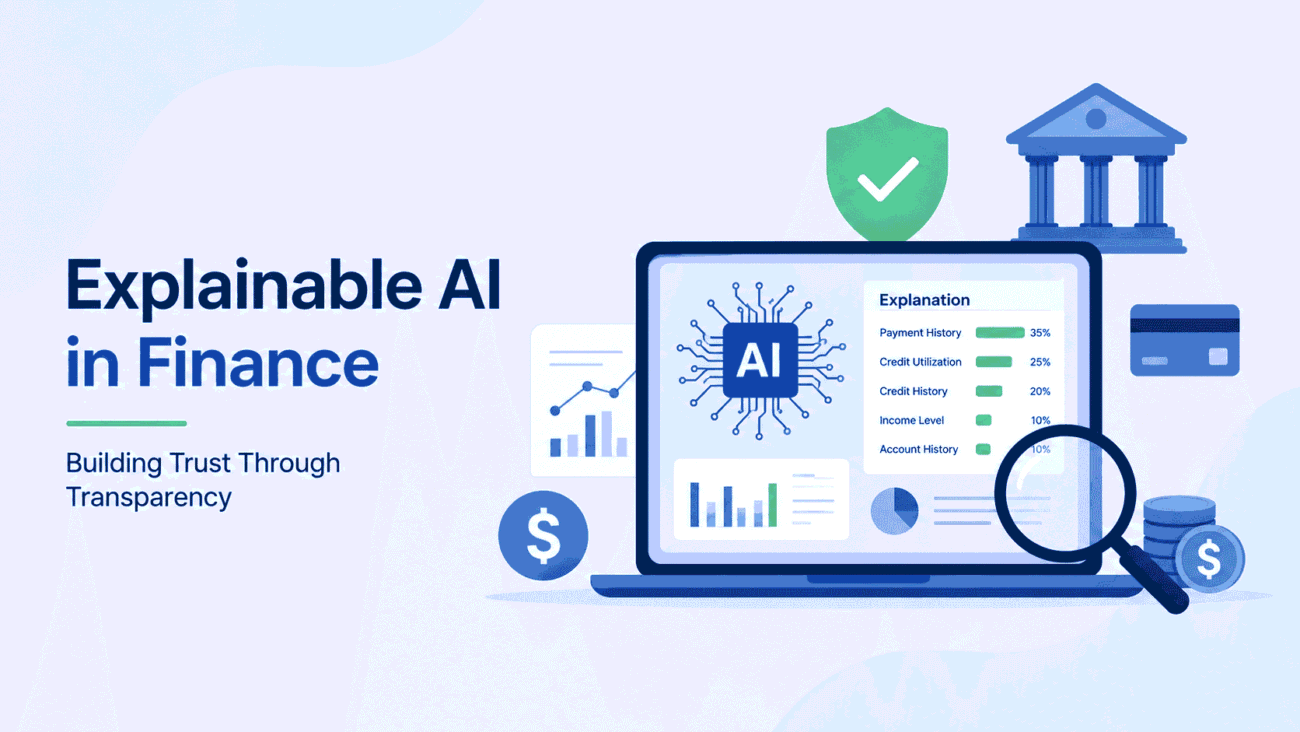
Artificial intelligence has transformed the financial industry. Banks use it to detect fraud, lenders rely on it to evaluate loan applications, and investment firms analyze market trends with machine learning models. But as AI systems become more powerful, one important question continues to grow: How did the AI reach its decision?
That question is at the heart of explainable AI in finance. Instead of treating AI as a “black box” that produces answers without explanation, explainable AI helps people understand the reasoning behind those decisions. For financial institutions, this transparency builds trust, supports regulatory compliance, and improves decision-making.
Whether you’re a finance professional, student, business owner, or simply interested in how AI is changing banking and investing, understanding explainable AI has become increasingly valuable. This guide explores how it works, where it’s used, its advantages and challenges, and why it has become a major focus across the financial sector.
What Is Explainable AI in Finance?
Explainable AI (often shortened to XAI) refers to artificial intelligence systems that provide understandable reasons for their predictions or decisions.
In finance, this means an AI model doesn’t simply approve or reject a loan, flag a transaction, or recommend an investment. It also explains the factors that influenced its conclusion.
For example, instead of only rejecting a mortgage application, an explainable AI system might identify contributing factors such as:
- Limited credit history
- High debt-to-income ratio
- Recent missed payments
- Insufficient documented income
Providing this level of transparency helps both financial professionals and customers better understand the outcome.
Why Transparency Matters in Financial Decisions
Financial decisions often have significant consequences.
A declined loan, a blocked payment, or an investment recommendation can directly affect someone’s financial future. When those decisions come from AI systems, people naturally want to know why.
Transparent AI helps organizations:
- Build customer trust
- Improve internal decision-making
- Identify model errors
- Meet regulatory expectations
- Reduce bias
- Support human oversight
Without clear explanations, even highly accurate AI systems may face resistance from regulators, customers, and financial institutions themselves.
How Explainable AI Works
Different AI models produce explanations in different ways.
Some algorithms are naturally easier to understand, while others require additional tools to interpret their results.
Generally, explainable AI works by identifying which variables had the greatest influence on a prediction.
Imagine a fraud detection system reviewing a credit card purchase.
Instead of simply labeling the transaction as suspicious, the system might explain that it noticed:
- An unusually large purchase amount
- A new geographic location
- Spending outside normal customer behavior
- Multiple transactions within a short period
This explanation helps investigators determine whether the alert is justified.
Black-Box AI vs Explainable AI
Not every AI system is equally transparent.
Some advanced machine learning models deliver excellent predictive accuracy but provide little insight into how decisions are made.
The table below highlights the differences.
| Feature | Black-Box AI | Explainable AI |
|---|---|---|
| Decision transparency | Low | High |
| Easy for humans to understand | No | Yes |
| Regulatory support | More challenging | Better suited |
| Customer trust | Lower | Higher |
| Error investigation | More difficult | Easier |
Many financial institutions now seek a balance between prediction accuracy and explainability rather than focusing on only one objective.
Where Explainable AI Is Used in Finance
Explainable AI has applications across nearly every area of modern financial services.
Credit Risk Assessment
Banks evaluate thousands of loan applications every day.
AI models analyze financial information to estimate repayment risk, while explainable systems clarify why certain applications receive approval or rejection.
Loan officers can then review those explanations before making final decisions.
Fraud Detection
Fraud detection systems constantly monitor transactions for unusual behavior.
Explainable AI helps investigators understand why a payment was flagged instead of forcing them to trust an unexplained prediction.
This reduces unnecessary investigations while improving confidence in automated systems.
Investment Management
Investment firms increasingly use AI to analyze market trends, company performance, and economic indicators.
Explainable AI allows portfolio managers to understand which market signals influenced investment recommendations rather than relying solely on automated outputs.
Insurance Underwriting
Insurance companies use AI to evaluate applications and estimate risk.
Explainable models provide additional clarity when determining premiums or reviewing claims, helping both staff and customers understand important factors.
Regulatory Compliance
Financial institutions operate under strict regulations.
Explainable AI assists compliance teams by documenting how automated decisions were reached, making audits and regulatory reviews much more manageable.
Benefits of Explainable AI in Finance
Organizations adopt explainable AI for several reasons beyond regulatory compliance.
Better Customer Trust
People are more likely to accept difficult financial decisions when they receive understandable explanations.
Even if the outcome remains unchanged, transparency often improves customer satisfaction.
Improved Risk Management
Understanding why AI reached a conclusion helps analysts identify unusual patterns, potential errors, or unexpected behavior before problems become larger.
Easier Model Validation
Data scientists regularly evaluate AI models to ensure they perform as expected.
Explainable AI makes it easier to verify whether predictions rely on meaningful financial information rather than accidental correlations.
Stronger Regulatory Readiness
Many financial regulations emphasize fairness, accountability, and documentation.
Explainable systems make it easier to demonstrate responsible AI use during regulatory reviews.
Challenges of Implementing Explainable AI
Although explainable AI offers many advantages, implementation is not always straightforward.
One challenge involves balancing accuracy with simplicity.
Highly complex AI models often achieve excellent predictive performance but may produce explanations that are difficult for non-technical users to understand.
Another challenge is consistency.
Different explanation methods can sometimes interpret the same prediction differently, making standardization difficult across large organizations.
Data quality also plays a critical role.
Even the most transparent AI system cannot overcome inaccurate, incomplete, or biased training data.
Finally, financial institutions must carefully protect sensitive customer information while providing meaningful explanations.
Real-World Example of Explainable AI
Imagine two customers apply for similar personal loans.
Traditional AI may approve one application and reject the other without any explanation.
With explainable AI, loan officers can review the reasoning behind each decision.
One applicant may have stronger payment history despite a slightly lower income, while another may carry higher outstanding debt that increases lending risk.
These explanations help financial professionals verify that the decision aligns with lending policies and reduces the likelihood of hidden model bias.
Understanding the Bussmann Explainable AI in Finance 2021 Reference
If you’ve researched this topic, you may have encountered Bussmann Explainable AI in Finance 2021.
This reference is commonly associated with academic discussions exploring how explainable AI can improve transparency, accountability, and trust within financial machine learning systems.
The work contributed to broader conversations around balancing predictive performance with interpretability, especially as regulators and financial institutions increased their focus on responsible AI adoption.
Although AI technology has continued to evolve since 2021, many of the principles discussed—including transparency, fairness, governance, and human oversight—remain highly relevant today.
How Financial Institutions Implement Explainable AI
Adding explainable AI to an existing financial system isn’t as simple as installing new software. It usually involves updating data processes, reviewing AI models, and training employees to understand AI-generated explanations.
A successful implementation often starts with identifying high-impact decisions where transparency matters most, such as lending, fraud detection, or investment recommendations.
Define Clear Business Goals
Before choosing an AI model, organizations should determine what they want to improve.
For example, a bank may want to:
- Increase loan approval accuracy
- Reduce fraudulent transactions
- Speed up customer service
- Improve regulatory reporting
Clear objectives make it easier to evaluate whether explainable AI is delivering value.
Use High-Quality Data
AI systems learn from historical information.
If training data contains errors, missing records, or hidden bias, the explanations produced by the model may also be misleading. Regular data reviews help improve both prediction quality and trustworthiness.
Include Human Oversight
Explainable AI works best when people remain involved in important decisions.
Financial professionals can review AI recommendations, ask additional questions, and consider factors that may not appear in the available data.
Rather than replacing human expertise, explainable AI supports better-informed decisions.
Popular Explainability Methods
Different AI models require different approaches to explain their predictions. Some techniques provide global insights into how an entire model behaves, while others explain individual decisions.
| Method | Best Used For | Main Advantage | Limitation |
|---|---|---|---|
| Feature Importance | Understanding key decision factors | Easy to interpret | Doesn’t explain every prediction in detail |
| SHAP (SHapley Additive Explanations) | Individual predictions | Detailed and consistent explanations | Can require more computing power |
| LIME (Local Interpretable Model-agnostic Explanations) | Local decision analysis | Works with many AI models | Results may vary between runs |
| Decision Trees | Transparent models | Naturally easy to understand | Less effective for highly complex problems |
Financial institutions often combine multiple explainability techniques depending on the type of AI model they’re using.
Common Mistakes When Using Explainable AI
Explainability adds value, but only when implemented correctly.
One common mistake is assuming that every explanation is automatically accurate. Explanations should be reviewed alongside business knowledge rather than accepted without question.
Another issue is focusing only on model performance. A highly accurate model that no one understands may still create regulatory or operational challenges.
Some organizations also overlook documentation. Keeping records of how AI models are trained, tested, and updated makes future audits much easier.
Finally, explainability should not become a one-time project. AI models should be monitored regularly as customer behavior, financial markets, and regulations evolve.
Expert Tips for Building Trustworthy AI Systems
Organizations that successfully use explainable AI often follow a few practical principles.
Start with simpler models whenever possible. If a transparent model delivers similar performance to a more complex one, it may be the better long-term choice.
Test explanations with both technical and non-technical teams. A data scientist and a loan officer should each be able to understand why the AI reached a particular conclusion, even if the level of detail differs.
Review models regularly. Market conditions, customer behavior, and lending patterns change over time, so AI systems should be updated and validated on an ongoing basis.
Maintain detailed documentation. Clear records of model design, data sources, testing procedures, and updates support governance and simplify compliance reviews.
The Future of Explainable AI in Finance
Artificial intelligence will continue playing a larger role across banking, insurance, investment management, and financial planning. At the same time, expectations for transparency are increasing.
Future explainable AI systems are likely to provide clearer visual explanations, better reporting tools, and stronger integration with governance frameworks.
As regulations continue to evolve, financial institutions may also face greater expectations to demonstrate that AI-driven decisions are fair, understandable, and free from unintended bias.
The goal isn’t simply to build smarter AI—it is to build AI that people can trust.
Pros and Cons of Explainable AI in Finance
| Pros | Cons |
|---|---|
| Builds customer trust | Can increase development complexity |
| Supports regulatory compliance | Some explanation methods require additional computing resources |
| Helps identify model bias | Highly complex models may still be difficult to interpret |
| Improves internal decision-making | Requires continuous monitoring and validation |
| Makes AI decisions easier to audit | Implementation can require specialized expertise |
FAQs
What is explainable AI in finance?
Explainable AI in finance refers to artificial intelligence systems that provide understandable reasons for their decisions, helping financial professionals and customers see why a prediction or recommendation was made.
Why is explainability important in banking?
Banks handle decisions that directly affect people’s finances, such as loan approvals and fraud detection. Transparent AI helps build trust, supports compliance, and allows employees to review automated decisions more effectively.
Does explainable AI reduce bias?
Explainable AI can help identify patterns that may indicate bias, but it does not eliminate bias on its own. High-quality data, regular testing, and human oversight are still essential.
What is the significance of Bussmann Explainable AI in Finance 2021?
The 2021 publication is widely referenced in discussions about responsible AI because it highlighted the importance of transparency, interpretability, and governance in financial machine learning. Many of its concepts continue to influence research and industry practices.
Can explainable AI replace financial professionals?
No. Explainable AI is designed to support decision-making rather than replace experienced professionals. Human judgment remains important for reviewing recommendations, considering unique situations, and ensuring ethical outcomes.
Conclusion
As artificial intelligence becomes more deeply integrated into financial services, understanding how automated decisions are made is no longer optional. Explainable AI in finance gives organizations a way to combine advanced analytics with transparency, making AI-driven decisions easier to understand, validate, and trust.
From credit risk assessment and fraud detection to investment management and regulatory compliance, explainable AI helps bridge the gap between complex machine learning models and real-world business decisions. It also strengthens customer confidence by providing meaningful explanations instead of unexplained outcomes.
Research, including discussions surrounding Bussmann Explainable AI in Finance 2021, has reinforced the importance of responsible AI practices that prioritize fairness, accountability, and human oversight. As technology continues to evolve, financial institutions that invest in transparent AI systems will be better positioned to meet regulatory expectations while building stronger relationships with customers.
