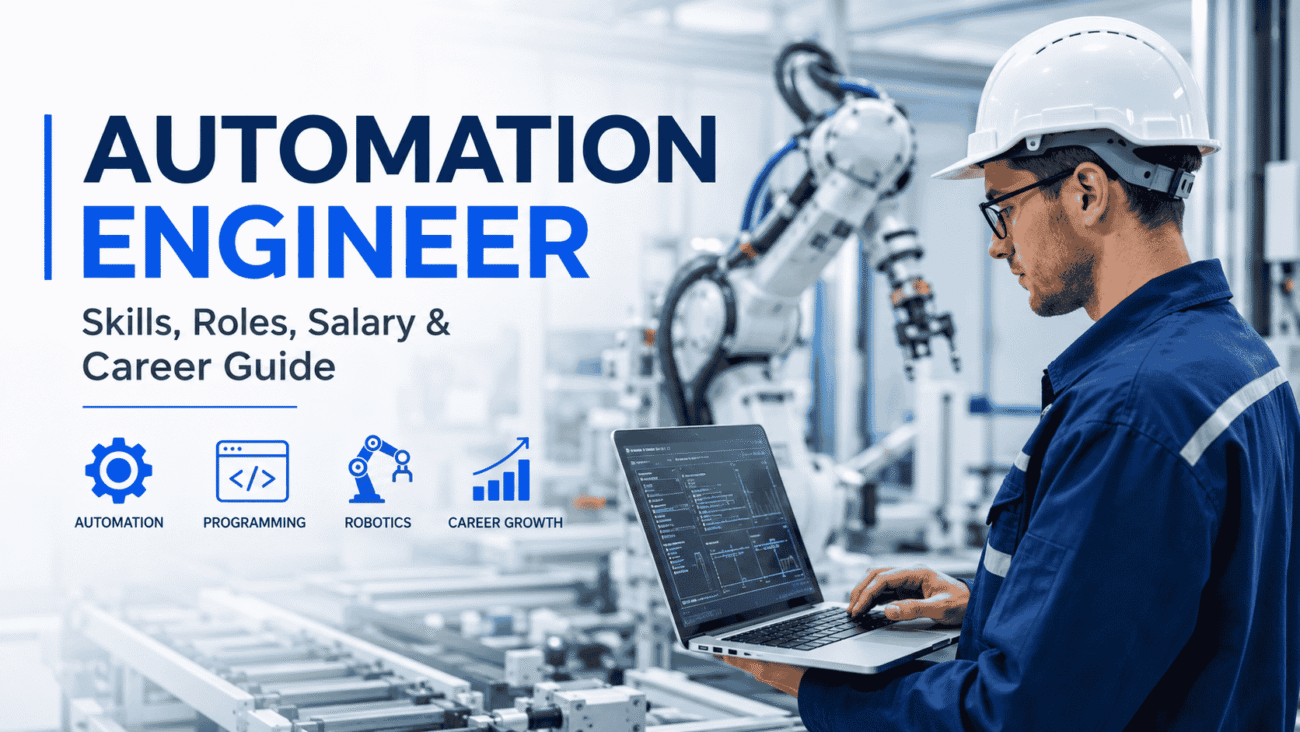
If you’ve ever wondered who designs the systems that keep factories running, software testing efficient, or production lines moving with minimal human intervention, the answer is often an automation engineer. These professionals build, improve, and maintain automated systems that help businesses work faster, reduce errors, and increase productivity.
Automation engineering isn’t limited to manufacturing anymore. Today, automation engineers work in industries ranging from healthcare and logistics to finance and software development. Whether they’re programming industrial robots or creating automated test scripts, their goal is the same: replace repetitive manual tasks with reliable automated processes.
In this guide, you’ll learn what an automation engineer does, the skills employers look for, career paths, the outlook for automation engineer jobs, how the role differs from a QA automation engineer, and what influences an automation engineer salary in the United States.
What Is an Automation Engineer?
An automation engineer is a technology professional who designs, develops, tests, and maintains automated systems that improve efficiency and reduce manual work.
Depending on the industry, automation can involve machinery, robotics, software, cloud infrastructure, or quality assurance testing. Some engineers spend their days working with industrial control systems, while others write code that automatically tests applications before they’re released to customers.
Although the tools vary, the objective remains consistent: create systems that perform tasks accurately with minimal human intervention.
What Does an Automation Engineer Do?
The responsibilities of an automation engineer depend on the organization and industry.
A typical day may include:
- Designing automation workflows
- Writing and testing automation scripts
- Troubleshooting system failures
- Improving existing automated processes
- Working with software developers or production teams
- Monitoring system performance
- Maintaining documentation
- Identifying opportunities for process improvement
Some roles focus almost entirely on programming, while others combine engineering, operations, and project management.
Industries That Hire Automation Engineers
Automation has become essential across many sectors.
As businesses continue adopting new technologies, demand for skilled automation professionals continues to grow.
Common industries include:
- Manufacturing
- Automotive
- Software development
- Healthcare
- Banking
- Logistics
- Aerospace
- Energy
- Telecommunications
- Pharmaceuticals
Because automation solves different problems in each industry, engineers often specialize over time.
Types of Automation Engineers
Automation engineering includes several specialized career paths.
Industrial Automation Engineer
Industrial automation engineers work with manufacturing equipment, robotics, programmable logic controllers (PLCs), sensors, and production systems.
Their work helps factories improve efficiency while reducing downtime.
Process Automation Engineer
These engineers optimize business or industrial processes.
Instead of focusing only on machines, they improve workflows that connect multiple systems together.
DevOps Automation Engineer
DevOps professionals automate software deployment, infrastructure management, and cloud operations.
Automation allows development teams to release updates faster while maintaining reliability.
QA Automation Engineer
A QA automation engineer specializes in software testing.
Instead of manually checking every feature, they create automated test scripts that verify whether software works correctly after updates.
This role has become increasingly important as software companies adopt continuous development and frequent product releases.
Skills Every Automation Engineer Needs
Success in automation engineering requires both technical expertise and problem-solving ability.
Programming Knowledge
Many automation engineers write code regularly.
Common programming languages include:
- Python
- Java
- C#
- JavaScript
- SQL
The preferred language often depends on the industry and automation tools being used.
Problem-Solving Skills
Automation projects rarely work perfectly on the first attempt.
Engineers must identify issues, analyze data, and develop practical solutions without disrupting operations.
Understanding Systems
Automation connects multiple technologies.
Successful engineers understand how hardware, software, networks, databases, and users interact within a larger system.
Communication Skills
Automation projects involve collaboration with managers, developers, technicians, and business stakeholders.
Being able to explain technical concepts clearly is just as valuable as writing code.
Common Tools Used by Automation Engineers
The exact tools vary by specialization.
Some widely used technologies include:
- Selenium
- Jenkins
- Git
- Docker
- Kubernetes
- PLC programming software
- SCADA systems
- REST APIs
- Test automation frameworks
- Cloud platforms
Rather than mastering every tool, experienced engineers focus on understanding the underlying concepts.
Learning new software becomes much easier when the fundamentals are strong.
Automation Engineer vs QA Automation Engineer
Although these job titles sound similar, their responsibilities differ.
| Automation Engineer | QA Automation Engineer |
|---|---|
| Automates business or industrial systems | Automates software testing |
| May work with robotics or manufacturing | Primarily works with software applications |
| Focuses on operational efficiency | Focuses on software quality |
| Often collaborates with operations teams | Works closely with developers and QA teams |
| Uses engineering and automation platforms | Uses testing frameworks and scripting tools |
Both careers require programming skills, but their day-to-day work can look very different.
Benefits of Becoming an Automation Engineer
Automation engineering offers several long-term career advantages.
High Demand Across Industries
Organizations continue investing in automation to improve efficiency and reduce operational costs.
As a result, qualified automation engineers remain valuable in many sectors.
Continuous Learning
Technology evolves quickly.
Engineers regularly learn new tools, programming languages, and automation platforms, making the career intellectually engaging.
Variety of Career Paths
Automation experience opens doors to roles in software development, DevOps, cloud engineering, systems architecture, project management, and technical leadership.
Many professionals build rewarding careers without staying in a single specialization.
Opportunity to Solve Real Problems
Automation engineers often improve systems that save businesses significant amounts of time and effort.
Seeing those improvements in action can be one of the most satisfying parts of the job.
Understanding Automation Engineer Salary
One of the first questions many people ask is about automation engineer salary.
The answer depends on several factors, including:
- Years of experience
- Industry
- Geographic location
- Technical skills
- Certifications
- Company size
- Job responsibilities
For example, an entry-level automation engineer typically earns less than someone leading enterprise automation projects or managing cloud infrastructure.
Likewise, salaries for a QA automation engineer may differ from those of engineers working in manufacturing or industrial automation.
Because compensation changes over time, job seekers should verify the latest salary information using reputable employment websites and official labor resources before making career decisions.
Automation Engineer Jobs: Where You Can Work
The demand for automation engineer jobs has expanded well beyond traditional manufacturing. Today, organizations in nearly every industry use automation to improve productivity, reduce manual work, and deliver services more efficiently.
Depending on your skills, you might work for:
- Technology companies
- Manufacturing plants
- Pharmaceutical companies
- Automotive manufacturers
- Financial institutions
- Healthcare organizations
- Logistics companies
- Energy providers
- Government agencies
- Engineering consulting firms
Some automation engineers work on-site with production equipment, while others build software solutions from an office or remotely.
Education and Qualifications
There isn’t one path that fits every automation engineer, but most employers expect a combination of education, technical knowledge, and practical experience.
Bachelor’s Degree
Many automation engineers have degrees in fields such as:
- Computer Science
- Software Engineering
- Electrical Engineering
- Mechanical Engineering
- Industrial Engineering
- Mechatronics
A degree provides a solid understanding of programming, systems, and engineering principles.
Certifications
Professional certifications can strengthen your resume, especially when changing careers or applying for specialized roles.
Examples include certifications related to:
- Cloud platforms
- DevOps
- PLC programming
- Industrial automation
- Software testing
- Project management
Employers usually value certifications most when they’re backed by hands-on experience.
Practical Projects
Many hiring managers pay close attention to real-world projects.
Building an automation script, contributing to an open-source project, or creating a home lab can demonstrate practical skills that go beyond classroom learning.
A Day in the Life of an Automation Engineer
No two days are exactly the same.
An automation engineer may start the morning reviewing overnight system reports, spend the afternoon troubleshooting a production issue, and finish the day testing a newly developed automation workflow.
For a QA automation engineer, the day might include updating automated test scripts, reviewing failed test results, working with developers to fix bugs, and preparing automated testing for an upcoming software release.
The variety keeps the role interesting and encourages continuous learning.
Essential Technical Skills
Technology changes quickly, but some core skills remain valuable across almost every automation role.
Programming
Writing clean, maintainable code is one of the most important abilities.
Python remains a popular choice because of its versatility, while Java, C#, and JavaScript are also common depending on the project.
Version Control
Most engineering teams use version control systems like Git.
Understanding how to track changes and collaborate with teammates is now considered a standard professional skill.
Databases
Automation often interacts with stored information.
Basic knowledge of SQL and database concepts helps engineers validate data and troubleshoot issues more efficiently.
APIs
Many automation projects connect different software systems.
Learning how APIs work allows engineers to automate data exchange between applications without manual intervention.
Soft Skills That Make a Difference
Technical knowledge alone isn’t enough.
Successful automation engineers also develop strong workplace skills.
Communication
Automation projects involve developers, managers, operators, and clients.
Explaining technical concepts in simple language helps everyone stay aligned.
Time Management
Automation projects often involve multiple deadlines.
Prioritizing tasks and staying organized becomes increasingly important as responsibilities grow.
Adaptability
Automation tools continue evolving.
Engineers who enjoy learning new technologies often find it easier to stay competitive throughout their careers.
Critical Thinking
Unexpected problems are part of the job.
Being able to analyze situations calmly and identify practical solutions is one of the qualities employers value most.
Common Mistakes Beginners Make
Starting a career in automation can feel overwhelming, especially with so many tools available.
Avoiding a few common mistakes can make learning much smoother.
Trying to Learn Every Tool
Many beginners jump between dozens of programming languages and frameworks.
A better approach is to build a strong foundation in one language before expanding to others.
The concepts usually transfer more easily than people expect.
Ignoring the Basics
It’s tempting to focus only on advanced automation tools.
However, understanding programming fundamentals, networking, databases, and operating systems provides a much stronger long-term foundation.
Avoiding Documentation
Documentation may not be exciting, but it’s an essential part of professional engineering.
Good documentation makes troubleshooting easier and helps teammates understand your work.
Skipping Real Projects
Watching tutorials is useful, but practical experience builds confidence.
Creating personal automation projects helps reinforce what you’ve learned while giving you something meaningful to showcase during interviews.
Pros and Cons of Becoming an Automation Engineer
| Pros | Cons |
|---|---|
| Strong demand across industries | Continuous learning is required |
| Opportunities for career growth | Some projects involve tight deadlines |
| Competitive earning potential | Troubleshooting can be time-consuming |
| Variety of technical challenges | Technology changes rapidly |
| Chance to solve real business problems | Some roles require on-call support |
For many professionals, the opportunity to build useful solutions and work with modern technology outweighs the challenges.
Expert Tips for Building a Successful Career
Experienced automation engineers often recommend focusing on long-term growth instead of chasing every new trend.
Build a Portfolio
Keep examples of automation projects you’ve completed.
A portfolio gives employers evidence of your skills and problem-solving abilities.
Learn One Tool Deeply
Understanding one automation framework thoroughly is often more valuable than having surface-level knowledge of many different tools.
Once you’ve mastered one platform, learning another becomes much easier.
Practice Debugging
Writing automation is only part of the job.
Finding and fixing problems efficiently is what separates experienced engineers from beginners.
Treat debugging as a skill worth developing.
Stay Current
Automation technology evolves every year.
Following industry blogs, attending webinars, and participating in technical communities can help you stay informed without feeling overwhelmed.
Is Automation Engineering a Good Career?
For many people, the answer is yes.
Automation engineers work on meaningful projects that improve efficiency and solve practical problems. The role combines creativity, logical thinking, and technical expertise, making it appealing to people who enjoy building and improving systems.
Career opportunities also extend across multiple industries, reducing the need to stay within a single field throughout your professional life.
Whether you begin as a junior engineer, specialize as a QA automation engineer, or eventually lead enterprise automation initiatives, the career offers plenty of room for growth and continued learning.
FAQs
What does an automation engineer do?
An automation engineer designs, develops, tests, and maintains automated systems that reduce manual work and improve efficiency. Depending on the industry, this may involve software automation, industrial machinery, robotics, cloud infrastructure, or business process automation.
Is automation engineering a good career in the USA?
Yes. Automation engineering remains a strong career choice because organizations across manufacturing, healthcare, finance, logistics, and technology continue investing in automation. Job opportunities and career growth vary by industry, location, experience, and technical skills, so it’s wise to review current employment trends before making career decisions.
What is the difference between an automation engineer and a QA automation engineer?
An automation engineer may work on industrial equipment, business processes, cloud systems, or software automation. A QA automation engineer focuses specifically on software quality by creating automated tests that verify applications before they are released. While both roles involve programming, their day-to-day responsibilities are different.
What skills are needed to become an automation engineer?
Most employers look for a combination of programming knowledge, problem-solving ability, system design, debugging skills, database fundamentals, version control experience, and strong communication. Practical project experience often carries as much weight as formal education.
How much does an automation engineer earn?
An automation engineer salary depends on several factors, including experience, education, certifications, industry, location, and job responsibilities. Salaries also differ between specialties such as industrial automation and QA automation. For the most accurate and up-to-date salary information, consult trusted employment websites or official labor resources.
Conclusion
An automation engineer plays a vital role in helping organizations improve efficiency, reduce repetitive work, and build more reliable systems. Whether working with manufacturing equipment, cloud infrastructure, or software testing, these professionals solve real-world problems through technology and innovation.
The growing demand for automation engineer jobs across industries means there are opportunities for people with different backgrounds and interests. Some professionals specialize in industrial systems, while others build careers as a QA automation engineer, focusing on automated software testing and quality assurance.
If you’re considering this career, focus on building strong programming fundamentals, gaining practical experience, and staying current with evolving technologies. Employers consistently value engineers who can adapt, communicate effectively, and solve problems with confidence.
As automation continues to shape industries across the United States, professionals who invest in continuous learning and hands-on experience will be well positioned for long-term career growth. Before making education or career decisions, remember to verify the latest information on automation engineer salary, certifications, and hiring trends using reputable industry sources.
