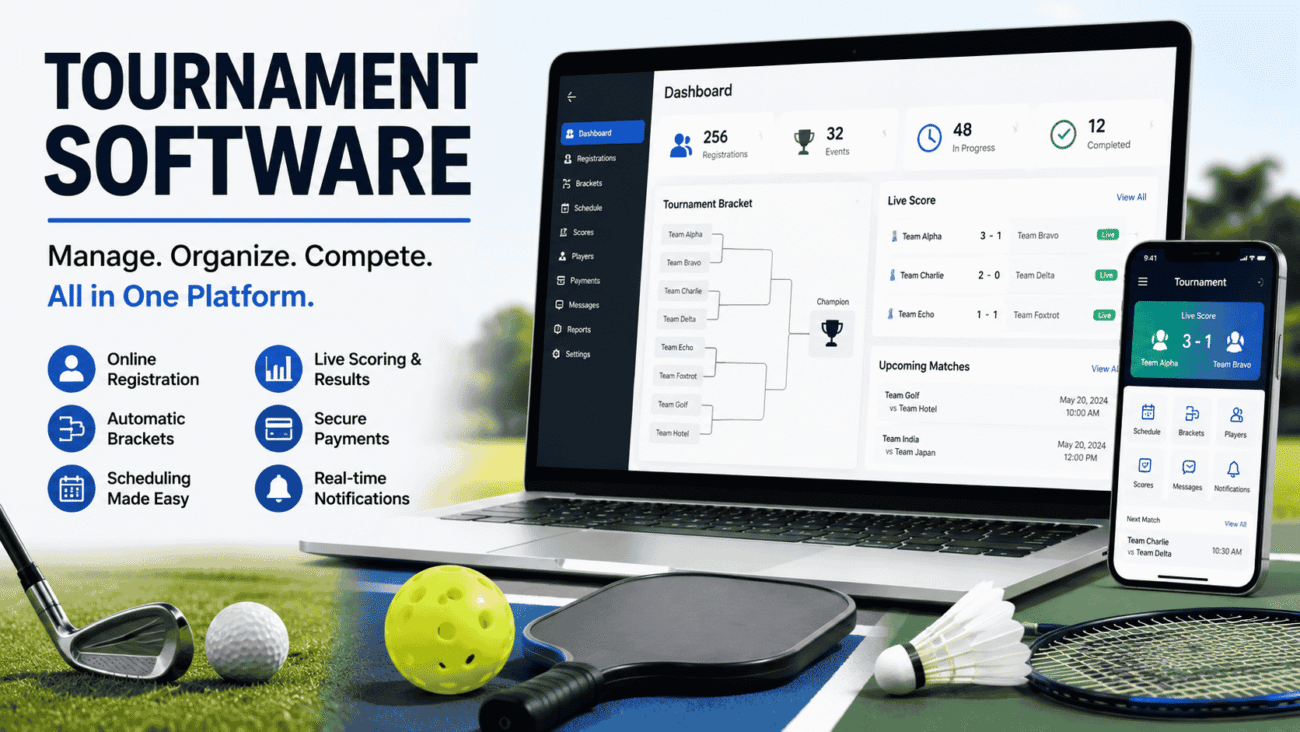
Whether you’re organizing a weekend golf fundraiser, a regional badminton championship, or a growing pickleball league, keeping everything organized can quickly become overwhelming. Registrations, brackets, schedules, payments, live scoring, and player communication all demand attention. That’s exactly where tournament software becomes valuable.
Instead of relying on spreadsheets and endless emails, tournament management platforms automate much of the work. They help organizers create brackets, accept registrations, update scores in real time, and provide players with an easier experience from registration through the final match.
This guide explains how tournament software works, what features matter most, and how to choose the right solution for your event.
What Is Tournament Software?
Tournament software is a digital platform designed to manage competitive events from beginning to end.
Depending on the sport, it can handle registrations, player databases, scheduling, score reporting, rankings, payments, and communication in one place.
Modern tournament software is used by:
- Sports clubs
- Schools and universities
- Recreation departments
- Professional event organizers
- Charity tournament organizers
- National sports associations
Instead of juggling multiple tools, organizers can manage nearly every aspect of an event through a single dashboard.
Why Tournament Software Has Become Essential
Sports events continue growing in size and complexity.
Even a local tournament may involve hundreds of participants, multiple venues, volunteer staff, officials, and spectators expecting live updates.
Tournament software reduces manual work while improving accuracy and communication.
Features Every Good Tournament Software Should Include
Not every platform offers the same capabilities.
The best solutions usually include several core features.
Online Registration
Participants should be able to register online within minutes.
A quality platform collects player information, emergency contacts, team details, waivers, and entry fees without requiring paper forms.
Automatic Bracket Generation
Creating brackets manually often leads to mistakes.
Tournament software automatically generates brackets based on the competition format, saving organizers hours of work.
Supported formats often include:
- Single elimination
- Double elimination
- Round robin
- Swiss system
- Pool play
- Custom formats
Live Score Updates
Players and spectators appreciate real-time results.
Instead of waiting for announcements, they can check scores from their phones throughout the event.
Scheduling Tools
Managing multiple courts, fields, or courses can be complicated.
Good tournament software prevents scheduling conflicts and adjusts matches when delays occur.
Payment Processing
Many platforms allow organizers to collect registration fees securely online.
This simplifies accounting while reducing administrative work on tournament day.
How Tournament Software Benefits Organizers
Running an event involves hundreds of small tasks.
Tournament software simplifies many of them.
Better Organization
Everything remains in one location instead of being spread across spreadsheets, paper documents, and messaging apps.
Faster Communication
Participants receive automatic updates about:
- Schedule changes
- Match assignments
- Weather delays
- Venue information
- Final results
This reduces confusion and cuts down on repetitive questions from players.
Improved Accuracy
Manual data entry often creates errors.
Automation reduces duplicate registrations, scheduling conflicts, and incorrect scoring.
Golf Tournament Software
Golf events have unique requirements compared to many other sports.
That’s why golf tournament software includes features specifically designed for golf competitions.
Typical capabilities include:
- Handicap management
- Tee time scheduling
- Live leaderboards
- Team scoring
- Hole-by-hole scoring
- Charity fundraising tools
- Sponsor management
Golf fundraisers especially benefit because organizers often need to manage sponsors, auctions, donations, and multiple competition formats alongside player registrations.
Example
Imagine organizing a charity golf tournament with 180 golfers.
Instead of assigning tee times manually, software automatically creates balanced groups, emails participants their schedules, collects registration fees, and updates the leaderboard throughout the day.
The organizer spends less time managing paperwork and more time ensuring everyone enjoys the event.
Pickleball Tournament Software
Few sports have grown as quickly in recent years as pickleball. With that growth comes the need for better tournament management.
Whether you’re organizing a local club event or a large regional competition, pickleball tournament software can simplify registration, scheduling, and scorekeeping while improving the experience for players and spectators.
Most pickleball platforms include features such as:
- Singles and doubles registration
- Skill and age divisions
- Automatic court assignments
- Live bracket updates
- Mobile score reporting
- Player notifications
- Waiting lists for full events
Because pickleball events often run multiple divisions at the same venue, scheduling tools are especially valuable.
Real-World Scenario
Imagine hosting a tournament with 250 players across beginner, intermediate, and advanced divisions.
Without software, updating brackets after every match could take hours. With the right platform, results appear almost instantly, and players receive notifications about their next match without visiting the tournament desk.
Tournament Software for Badminton
Badminton tournaments often involve multiple courts, age categories, and event types such as singles, doubles, and mixed doubles.
This makes scheduling particularly challenging.
Specialized tournament software badminton solutions are designed to handle these complexities.
Common features include:
- Multi-court scheduling
- Match sequencing
- Seeded draws
- Round robin groups
- Knockout brackets
- Umpire assignments
- Real-time rankings
These tools help reduce delays while ensuring players receive fair scheduling throughout the competition.
Comparing Tournament Software by Sport
Although the core purpose remains the same, different sports require different features.
| Feature | Golf Tournament Software | Pickleball Tournament Software | Badminton Tournament Software |
|---|---|---|---|
| Online Registration | Yes | Yes | Yes |
| Automatic Brackets | Limited | Yes | Yes |
| Tee Time Scheduling | Yes | No | No |
| Court Management | No | Yes | Yes |
| Live Scoring | Yes | Yes | Yes |
| Handicap Support | Yes | No | No |
| Doubles Management | Optional | Yes | Yes |
| Mobile Updates | Yes | Yes | Yes |
Choosing software designed for your sport usually delivers a better experience than using a generic event management platform.
How to Choose the Right Tournament Software
Not every organizer has the same needs.
Before selecting a platform, consider a few important questions.
How Many Participants Will You Have?
A weekend tournament with 40 players requires different tools than a national championship with several thousand competitors.
Choose software that can comfortably handle your expected number of participants.
Which Tournament Format Do You Use?
Some sports rely heavily on round robin play, while others use single elimination or Swiss formats.
Verify that the software supports your preferred competition structure.
Will Participants Register Online?
Online registration saves organizers significant time.
It also reduces data entry errors and allows players to receive instant confirmation after signing up.
Does It Work on Mobile Devices?
Many players expect to view schedules, brackets, and scores on their phones.
Mobile-friendly software creates a much smoother experience.
Common Mistakes When Choosing Tournament Software
Many organizers purchase software based only on price.
That can lead to frustration later.
Ignoring Ease of Use
Powerful software isn’t useful if volunteers struggle to learn it.
Look for a clean interface that’s easy to navigate during busy tournament days.
Choosing Features You Don’t Need
Some enterprise-level platforms include advanced tools that smaller events never use.
Paying for unnecessary features increases costs without improving the event.
Forgetting Customer Support
Technical issues occasionally happen.
Responsive customer support becomes extremely valuable when your tournament begins in just a few hours.
Not Testing Before Event Day
Always run a practice tournament before hosting a live competition.
Testing registration, scheduling, scoring, and reporting helps identify potential problems early.
Expert Tips From Experienced Tournament Directors
Experienced organizers often follow a few best practices regardless of the sport.
- Open registration several weeks before the event.
- Test every scoring feature before tournament day.
- Keep participant contact information updated.
- Publish schedules early whenever possible.
- Have one person responsible for managing software during the event.
- Back up important tournament data regularly.
These habits reduce stress while helping events run more smoothly from start to finish.
Pros and Cons of Tournament Software
Every tournament management platform has advantages and limitations. Understanding both helps you choose software that fits your event rather than paying for features you’ll never use.
| Pros | Cons |
|---|---|
| Saves hours of administrative work | Some platforms require a learning curve |
| Reduces scheduling and scoring errors | Advanced features may cost extra |
| Improves the player experience | Internet access may be needed for live updates |
| Supports online registration and payments | Premium plans can be expensive for small events |
| Provides live brackets and results | Staff may need training before the event |
For most organizers, the time saved and reduction in manual work outweigh the disadvantages.
Real-World Example
Consider a community recreation center hosting a weekend sports festival with golf, pickleball, and badminton tournaments.
Without tournament software, volunteers would likely manage registrations through email, build brackets manually, print schedules, and update scores on paper.
Now imagine using a tournament management platform instead.
Players register online, payments are collected automatically, schedules are generated in minutes, and match results appear instantly on participants’ phones. Volunteers spend less time answering routine questions because players can view updates themselves.
The tournament runs more efficiently, and participants leave with a better overall experience.
Future Trends in Tournament Software
Tournament software continues to evolve as sports organizations adopt new technology.
Several trends are becoming increasingly common.
Mobile-First Platforms
Many newer systems are designed primarily for smartphones, allowing organizers, officials, and players to manage events without needing a desktop computer.
Live Streaming Integration
Some platforms now connect directly with live-streaming services, making it easier for spectators to watch matches while following scores in real time.
AI-Assisted Scheduling
Artificial intelligence is beginning to help organizers create more balanced schedules by considering court availability, player rest periods, and travel times.
Better Analytics
Modern platforms increasingly provide detailed reports that help organizers evaluate attendance, registration trends, and event performance.
These features can improve future tournaments by highlighting what worked well and where adjustments may be be needed.
FAQs
What is tournament software used for?
Tournament software helps organizers manage registrations, scheduling, brackets, scoring, payments, and communication throughout a competition.
Is tournament software suitable for small events?
Yes. Many platforms offer plans designed for local clubs, schools, and community organizations, making them useful even for smaller tournaments.
What is the best golf tournament software?
The best golf tournament software depends on your event’s needs. Look for features such as handicap management, tee time scheduling, live leaderboards, online registration, and payment processing rather than focusing only on price.
Can pickleball tournaments be managed online?
Absolutely. Modern pickleball tournament software allows organizers to handle registrations, court assignments, live brackets, score reporting, and player notifications through one platform.
Does badminton tournament software support different competition formats?
Most dedicated badminton tournament software supports singles, doubles, mixed doubles, round robin groups, knockout brackets, and seeded draws.
Conclusion
Organizing a successful tournament takes much more than creating a bracket. From registrations and payments to scheduling, scoring, and communication, every detail affects the player experience.
The right tournament software brings all of those tasks together in one system, reducing manual work while helping events run more smoothly. Whether you’re planning a charity golf outing, a competitive badminton championship, or a fast-growing pickleball tournament, choosing software that matches your sport and event size will save time and minimize unnecessary stress.
Before making a decision, compare features carefully, test the platform in advance, and focus on the tools that genuinely improve your workflow. A well-managed tournament benefits everyone—from organizers and volunteers to players and spectators.
