Building software from scratch every time is no longer practical. Modern applications are expected to launch faster, scale easily, and adapt to changing business needs. That’s one of the biggest reasons component-based software engineering (CBSE) has become an important software development approach.
Instead of creating every feature from the ground up, CBSE encourages developers to build applications using reusable software components. Think of these components as building blocks. Each one performs a specific task and can be combined with others to create larger, more complex systems.
This approach saves development time, improves consistency, and makes software easier to maintain. Whether you’re a computer science student, a software developer, or a business owner evaluating development strategies, understanding component-based software engineering can help you appreciate how many modern applications are built.
In this guide, we’ll explore how CBSE works, its key principles, advantages, challenges, practical examples, and the best practices for implementing it successfully.
What Is Component-Based Software Engineering?
Component-based software engineering is a software development methodology that focuses on designing applications by assembling independent, reusable software components.
A component is a self-contained piece of software that performs a specific function while communicating with other components through clearly defined interfaces.
Unlike traditional development, where large portions of code are tightly connected, CBSE separates functionality into smaller modules that can often be developed, tested, updated, and reused independently.
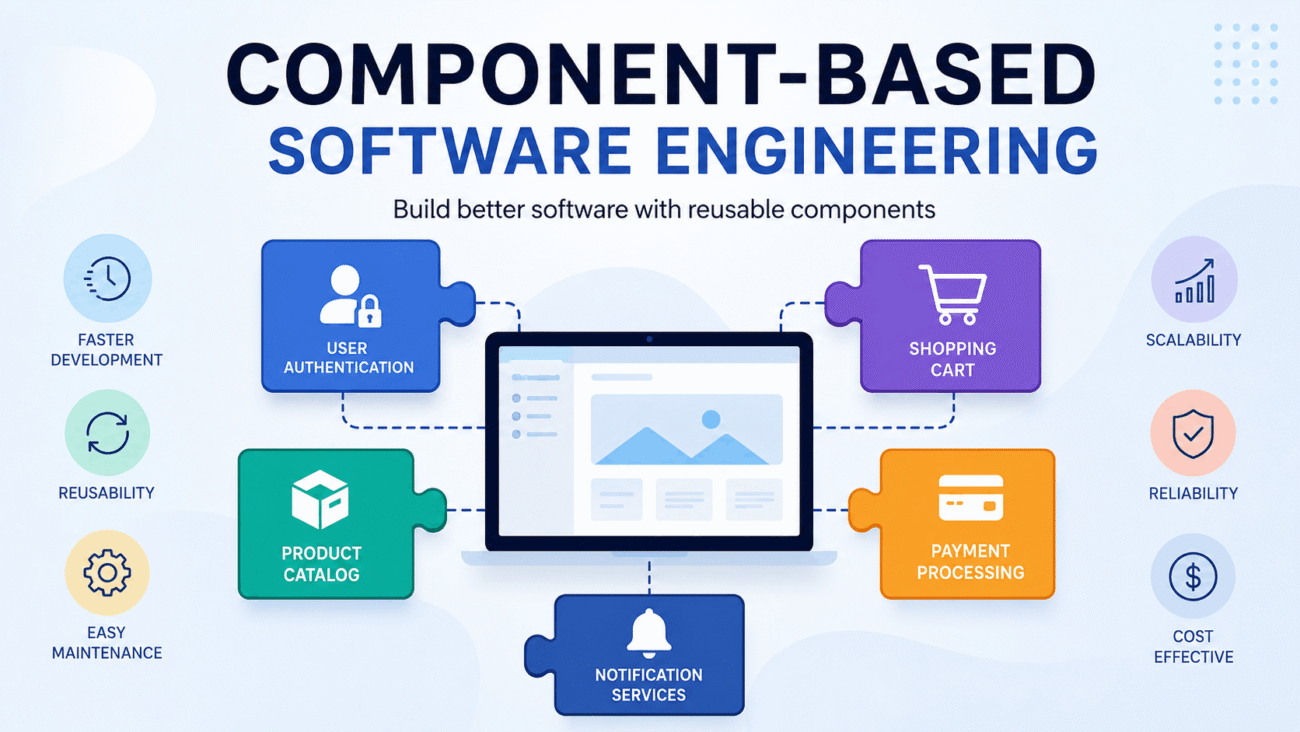
For example, an online shopping application may include separate components for:
- User authentication
- Product catalog
- Shopping cart
- Payment processing
- Order management
- Notification services
Each component performs a dedicated role while working together to deliver the complete application.
Why Is Component-Based Software Engineering Important?
As software projects become larger and more complex, managing a single codebase becomes increasingly difficult.
CBSE addresses this challenge by breaking applications into manageable pieces that are easier to understand and maintain.
Some of its biggest advantages include:
- Faster software development
- Better code reusability
- Simplified maintenance
- Easier scalability
- Improved testing
- Reduced development costs
- Greater flexibility
Instead of rewriting existing functionality, developers can reuse proven components across multiple projects, saving valuable time while improving reliability.
Core Principles of Component-Based Software Engineering
Successful CBSE projects are built around several fundamental principles.
Reusability
One of the defining characteristics of CBSE is software reuse.
Rather than creating similar functionality repeatedly, developers design components that can be used in multiple applications with little or no modification.
For example, a login component created for one business application might also work in another project after minimal configuration.
Modularity
Each component should focus on one primary responsibility.
Keeping components modular makes them easier to understand, update, and replace without affecting unrelated parts of the system.
Smaller modules also simplify debugging because developers can isolate problems more quickly.
Loose Coupling
Components should interact with one another without becoming overly dependent.
Loose coupling allows developers to replace or update one component without rewriting the entire application.
This flexibility becomes especially valuable as software evolves over time.
High Cohesion
A well-designed component performs one clear purpose exceptionally well.
Mixing unrelated responsibilities into the same module creates unnecessary complexity and makes future maintenance more difficult.
Encapsulation
Each component hides its internal implementation details.
Other components interact only through published interfaces, reducing accidental dependencies and improving security.
How Component-Based Software Engineering Works
Although every development team follows its own workflow, most CBSE projects include similar stages.
Step 1: Requirements Analysis
The project begins by identifying the features users need.
Instead of thinking about the application as one large program, developers divide requirements into smaller functional areas.
Step 2: Component Identification
Next, developers determine which components are required.
Typical examples include:
- Authentication
- Database access
- Email services
- Logging
- Reporting
- Payment gateways
Existing reusable components may already satisfy some of these requirements.
Step 3: Component Design
Each component receives clearly defined responsibilities.
Developers establish:
- Inputs
- Outputs
- Interfaces
- Dependencies
- Security requirements
Good planning at this stage reduces integration problems later.
Step 4: Component Development
Once the design is complete, development teams build or customize each component.
Because components are largely independent, multiple developers can work simultaneously without constantly interfering with one another.
This parallel development often speeds up project completion.
Step 5: Integration
Individual components are connected through their interfaces.
Integration testing verifies that they communicate correctly and produce the expected results.
Step 6: Testing and Maintenance
Testing continues after deployment.
Since components remain separate, updates usually affect only the specific module being modified instead of the entire application.
This reduces maintenance costs while making future enhancements easier.
Characteristics of Good Software Components
Not every software module qualifies as a reusable component.
Effective components generally share several characteristics.
| Characteristic | Why It Matters |
|---|---|
| Reusable | Can be used across multiple applications |
| Independent | Operates with minimal dependencies |
| Replaceable | Can be updated without changing the whole system |
| Well Documented | Simplifies implementation |
| Testable | Supports independent testing |
| Reliable | Produces consistent results |
These qualities help development teams build applications that remain maintainable for years.
Real-World Examples
Many modern software systems rely on component-based principles.
For example:
E-commerce Platforms
An online store often separates payment processing, inventory management, product search, customer authentication, and shipping calculations into independent components.
When one service needs updating, developers can modify that component without disrupting unrelated features.
Banking Applications
Banks commonly divide systems into components responsible for customer accounts, transaction processing, fraud detection, reporting, and notifications.
This modular approach improves both maintainability and security.
Healthcare Systems
Hospitals often use separate components for appointment scheduling, patient records, billing, laboratory results, and prescription management.
Independent modules make it easier to upgrade specific services while minimizing downtime.
Advantages of Component-Based Software Engineering
One of the main reasons organizations adopt component-based software engineering is its ability to simplify software development without sacrificing quality. By dividing applications into reusable, independent modules, teams can spend less time rebuilding existing features and more time delivering value.
Faster Development
Developers don’t have to reinvent the wheel for every project. Existing components can often be reused with little or no modification, allowing new applications to reach production more quickly.
This is especially valuable for businesses working under tight deadlines or releasing frequent software updates.
Easier Maintenance
Maintaining a large application becomes much more manageable when it’s organized into separate components.
If a bug appears in one module, developers can usually fix that component without affecting unrelated parts of the application. This reduces downtime and minimizes the risk of introducing new issues elsewhere.
Improved Scalability
Modern applications need to grow alongside business requirements.
With CBSE, individual components can often be upgraded or replaced independently. For example, an e-commerce platform experiencing increased traffic may scale its payment or inventory components without redesigning the entire system.
Better Code Reusability
Reusability is one of CBSE’s biggest strengths.
A well-designed authentication component, for instance, can be shared across multiple applications within the same organization. This saves development time while encouraging consistent security practices.
Simplified Testing
Independent components are easier to test than tightly connected systems.
Developers can verify each module on its own before integrating it into the complete application. Finding and fixing problems early generally leads to more stable software.
Challenges of Component-Based Software Engineering
Although CBSE offers many advantages, it isn’t the perfect solution for every project. Understanding its limitations helps teams plan more effectively.
Integration Complexity
Components developed by different teams—or obtained from third-party vendors—may not always work together seamlessly.
Ensuring compatibility often requires careful planning, well-defined interfaces, and thorough integration testing.
Dependency Management
Many components rely on external libraries or supporting services.
If one dependency becomes outdated or unsupported, it may affect several parts of the application. Keeping dependencies current is an ongoing responsibility.
Version Compatibility
As components evolve, new versions may introduce changes that aren’t compatible with older systems.
Organizations should establish clear version management practices to avoid unexpected issues during upgrades.
Learning Curve
Teams that are accustomed to traditional software development may need time to adapt to component-based design principles.
Investing in training and documentation can make this transition much smoother.
Component-Based Software Engineering vs. Traditional Software Engineering
Although both approaches aim to build reliable applications, they differ in how software is organized and maintained.
| Feature | Component-Based Software Engineering | Traditional Software Engineering |
|---|---|---|
| Development Style | Modular and reusable | Often built as one integrated system |
| Code Reuse | High | Limited |
| Maintenance | Easier | Can become more complex over time |
| Scalability | Flexible | May require significant redesign |
| Testing | Individual components can be tested separately | Testing often focuses on the complete application |
| Development Speed | Faster when reusable components exist | Usually slower for large projects |
For organizations building multiple applications or maintaining long-term software products, CBSE often provides greater flexibility and efficiency.
Best Practices for Successful CBSE
Simply dividing software into modules isn’t enough. Successful component-based development requires thoughtful planning and consistent design practices.
Design Components with a Single Responsibility
Each component should solve one specific problem.
When modules try to handle multiple unrelated tasks, they become difficult to maintain and less reusable.
Define Clear Interfaces
Components should communicate through well-documented interfaces.
Clear interfaces reduce confusion, improve compatibility, and make future upgrades much easier.
Document Every Component
Good documentation saves countless hours during development and maintenance.
Each component should include information about:
- Its purpose
- Input and output requirements
- Dependencies
- Configuration options
- Version history
Test Components Independently
Testing individual modules before integration helps identify issues early.
Unit testing and integration testing should both be part of the development process.
Review Components Regularly
Technology evolves quickly.
Even reusable components should be reviewed periodically to improve performance, security, and compatibility with newer frameworks.
Common Mistakes to Avoid
Even experienced development teams can encounter problems when implementing component-based software engineering.
Here are some common mistakes and how to avoid them.
Creating Components That Are Too Large
A component responsible for dozens of unrelated tasks becomes difficult to reuse.
Keeping modules focused on a single responsibility improves flexibility.
Ignoring Documentation
Poor documentation often leads to confusion months or years later.
Future developers should be able to understand how a component works without reading every line of code.
Tight Coupling Between Components
When one component depends heavily on another, replacing or updating it becomes much more complicated.
Loose coupling keeps systems flexible and easier to maintain.
Overusing Third-Party Components
Reusable libraries save time, but relying on too many external components can create security risks and dependency issues.
Evaluate every third-party component before adding it to a project.
Expert Tips for Development Teams
Teams that succeed with CBSE usually share a few common habits.
Consider these recommendations:
- Establish coding standards before development begins.
- Reuse existing components whenever practical.
- Perform regular code reviews.
- Keep interfaces simple and consistent.
- Automate testing where possible.
- Monitor component performance after deployment.
- Remove outdated or unused components from the system.
Small improvements made consistently often have a much greater impact than large architectural changes introduced late in a project.
Real-World Scenario
Imagine a company developing both a customer portal and a mobile application.
Instead of building two separate authentication systems, developers create one secure login component.
That same component is then integrated into both applications.
Later, when stronger password policies and multi-factor authentication become necessary, the team updates only the authentication component. Both applications immediately benefit from the improvements without requiring duplicate development work.
This example demonstrates one of the greatest advantages of component-based software engineering: solving a problem once instead of solving it repeatedly.
FAQs
1. What is component-based software engineering?
Component-based software engineering (CBSE) is a software development approach that builds applications by combining reusable, self-contained software components. Each component performs a specific function and communicates with other components through well-defined interfaces. This modular approach helps improve development speed, maintainability, and software quality.
2. What are the main advantages of component-based software engineering?
Some of the most significant benefits include:
- Faster software development
- Better code reusability
- Easier maintenance
- Improved scalability
- Simpler testing
- Reduced long-term development costs
- Greater flexibility when updating applications
These advantages make CBSE a popular choice for organizations that build and maintain large software systems.
3. Is component-based software engineering suitable for every project?
Not necessarily.
For small applications with limited functionality, introducing reusable components may add unnecessary complexity. However, for medium-sized and enterprise-level projects that require ongoing maintenance and future expansion, CBSE often delivers considerable long-term value.
The decision should depend on the project’s size, expected lifespan, and business requirements.
4. How is CBSE different from object-oriented programming?
Although the two concepts are related, they solve different problems.
Object-oriented programming (OOP) focuses on organizing code into objects and classes, while component-based software engineering organizes entire applications into reusable software modules.
Many modern applications actually combine both approaches. Developers often build components internally using object-oriented programming principles while exposing the components through standardized interfaces.
5. What industries commonly use component-based software engineering?
CBSE is widely adopted across industries where software systems are large, complex, and expected to evolve over time.
Common examples include:
- Financial services
- Healthcare
- E-commerce
- Cloud computing
- Government systems
- Telecommunications
- Manufacturing
- Enterprise business software
Any organization that develops multiple applications or regularly updates existing software can benefit from a component-based approach.
Final Thoughts
Software development has changed dramatically over the past two decades. Businesses are expected to release new features quickly, respond to customer feedback, and keep applications secure without disrupting existing services. Meeting those expectations becomes much easier when software is built from flexible, reusable components instead of one large, tightly connected codebase.
That is exactly where component-based software engineering proves its value. By breaking applications into independent modules, development teams can reuse proven functionality, simplify maintenance, and introduce updates with far less risk. Instead of rebuilding the same features for every project, developers can focus their time on solving new business challenges and improving the overall user experience.
Of course, CBSE isn’t simply about dividing software into smaller pieces. Successful implementation depends on thoughtful architecture, clear interfaces, thorough documentation, and regular testing. Organizations that invest in these practices are more likely to build systems that remain reliable, scalable, and easier to maintain as technology evolves.
Whether you’re a computer science student learning software architecture, a developer working on enterprise applications, or a business leader evaluating development strategies, understanding component-based software engineering provides valuable insight into how many of today’s modern software systems are designed.
As software continues to become more connected and increasingly complex, the principles behind CBSE will remain highly relevant. Building reusable, maintainable, and well-structured components isn’t just a development technique—it’s a long-term investment in software quality.
Key Takeaways
Before wrapping up, here are the most important points to remember:
- Component-based software engineering focuses on building applications from reusable, independent components.
- Reusability reduces development time and helps maintain consistency across projects.
- Modular architecture makes applications easier to update, test, and scale.
- Well-defined interfaces allow components to communicate without becoming tightly coupled.
- Successful CBSE projects rely on careful planning, documentation, testing, and version management.
- The approach is widely used in enterprise software, cloud platforms, healthcare systems, banking applications, and e-commerce solutions.
Keeping these principles in mind can help development teams create software that is easier to maintain and better prepared for future growth.
