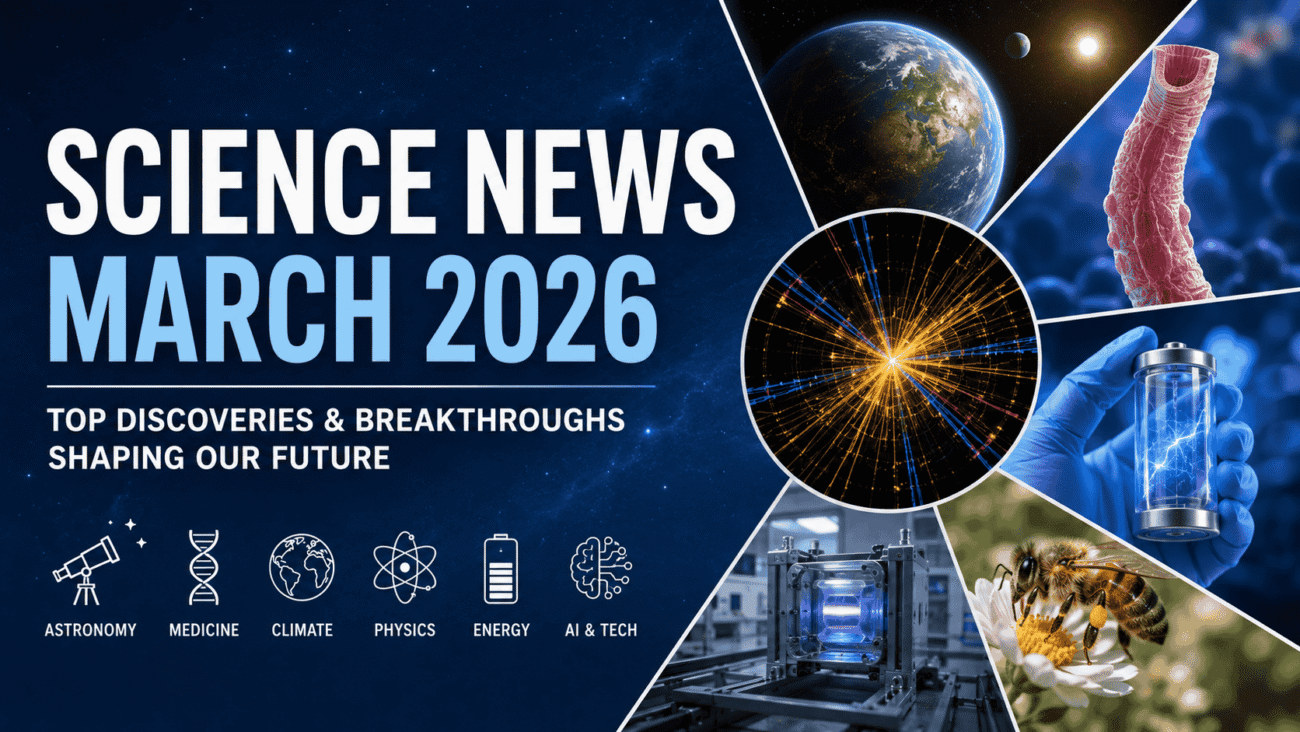
March 2026 delivered an impressive mix of discoveries across medicine, astronomy, climate science, physics, and biotechnology. Researchers announced potentially habitable exoplanets close to Earth, physicists confirmed a long-sought particle, medical teams demonstrated breakthroughs in tissue engineering, and climate scientists published new findings about the pace of global warming. These developments show how rapidly science continues to evolve while reminding us that many discoveries still require additional research before becoming everyday technologies.
If you’re looking for the latest science news March 2026, this guide brings together the month’s most important stories, explains why they matter, and puts each discovery into context.
Why March 2026 Was an Important Month for Science
Not every month produces breakthroughs across multiple scientific fields, but March 2026 stood out because discoveries emerged from several major research areas at the same time.
Scientists reported advances involving:
- Space exploration
- Medical engineering
- Climate research
- Quantum science
- Battery technology
- Particle physics
- Artificial intelligence
Some of these findings could eventually influence healthcare, transportation, renewable energy, and future space missions.
Space Science Continued to Deliver Big Discoveries
Astronomy remained one of the busiest research fields during March.
Several international research teams announced findings that expanded our understanding of planets beyond our solar system.
A Nearby Potentially Habitable Planet
Astronomers reported the discovery of GJ 887 d, a super-Earth orbiting within the habitable zone of a nearby red dwarf star approximately 10.7 light-years away. Because of its relatively close distance, the planet is expected to become an important target for future telescopes searching for atmospheric biosignatures.
Although scientists are not claiming that life exists there, the discovery gives researchers another promising world to study.
Forty-Five Exoplanets Selected for Future Investigation
Another international study identified 45 nearby exoplanets considered strong candidates for future habitability research.
Rather than declaring these worlds habitable, scientists created a priority list for next-generation telescopes that will search for atmospheric signs of life in the coming years.
This is a good example of how science progresses through careful planning instead of dramatic conclusions.
A Major Medical Breakthrough in Tissue Engineering
One of the most widely discussed medical stories involved researchers successfully creating a laboratory-grown esophagus.
Lab-Grown Organ Shows Promise
Scientists demonstrated that a bioengineered esophagus could replace a full section of the organ in animal studies while restoring normal swallowing without requiring immunosuppressive drugs. Although additional research and clinical testing remain necessary, experts believe this work could eventually benefit patients born with serious esophageal conditions or those requiring reconstructive surgery.
This represents another step forward in regenerative medicine rather than an immediately available treatment.
Climate Research Raised New Questions
Climate scientists also released research suggesting that global warming has accelerated during the past decade after accounting for natural climate variability.
The findings indicate that warming trends may be increasing faster than previously estimated, although researchers continue refining long-term climate projections using additional observations and updated models.
Studies like these help governments and scientists improve future climate planning.
Particle Physics Solved a Long-Standing Mystery
March also brought important news from CERN.
Discovery of the Ξcc⁺ Particle
Researchers working on the LHCb experiment confirmed the existence of the Ξcc⁺ (Xi-cc-plus) doubly charmed baryon, resolving a question that had challenged particle physicists for roughly two decades. The discovery improves scientists’ understanding of how quarks combine to form matter and provides additional evidence supporting current models of particle physics.
Although this discovery will not immediately affect daily life, it strengthens our understanding of the universe at its smallest scales.
Battery Research Moved Forward
Electric vehicles continue driving demand for better battery technology.
Researchers published the first direct measurements explaining how lithium dendrites behave inside batteries.
Lithium dendrites are tiny needle-like structures that can grow over time, increasing the risk of battery failure or short circuits. Understanding how they form could eventually help engineers design batteries that are both safer and longer lasting.
For consumers, this kind of research may eventually lead to more reliable electric vehicles and energy storage systems.
Artificial Intelligence Continued Expanding Scientific Research
Artificial intelligence remained a major topic throughout March, but many scientists emphasized that AI should be viewed as a research assistant rather than a replacement for human creativity.
Researchers highlighted AI systems that help analyze medical images, simulate complex scientific problems, and improve engineering workflows while noting that expert human judgment remains essential for interpreting results and developing new ideas.
This balanced perspective reflects how many research institutions now view AI—as a powerful tool rather than an independent scientist.
Other Notable Science News March 2026
March wasn’t defined by a single discovery. Instead, researchers across different disciplines published findings that could influence future studies for years to come.
Several announcements stood out because they combined scientific curiosity with practical applications.
Scientists Transported Antimatter Outside a Laboratory
For the first time, researchers successfully transported antimatter particles by road using a specially designed containment system. The experiment demonstrated that antimatter can be moved safely over short distances, an important step for future research involving precision measurements and advanced physics experiments.
While this doesn’t mean antimatter-powered technology is around the corner, it expands the possibilities for collaborative research between scientific facilities.
Honeybee Nutrition Research Offered New Hope
Another interesting science news March 2026 breakthrough came from researchers developing engineered yeast capable of producing nutrients that honeybees increasingly struggle to find in modern agricultural landscapes.
Colonies receiving the nutritional supplement produced significantly more developing young than untreated colonies. Scientists caution that additional research is still needed before large-scale implementation, but the study could eventually support pollinator conservation efforts.
Planetary Collision Observed Around a Distant Star
Astronomers also gathered evidence suggesting two planets collided around a distant star approximately 11,000 light-years from Earth.
Researchers detected unusual dimming and infrared signals consistent with debris created by a massive planetary impact. Events like this help scientists better understand how planetary systems evolve over billions of years.
Comparing March 2026’s Biggest Scientific Stories
Different discoveries affect society in different ways.
| Discovery | Scientific Field | Potential Long-Term Impact |
|---|---|---|
| Habitable-zone exoplanet | Astronomy | Search for life beyond Earth |
| Lab-grown esophagus | Medicine | Regenerative healthcare |
| Global warming acceleration study | Climate Science | Climate policy and planning |
| Discovery of Ξcc⁺ particle | Particle Physics | Better understanding of matter |
| Lithium dendrite research | Energy Storage | Safer batteries |
| Honeybee nutrition study | Biology | Pollinator conservation |
| Antimatter transport | Physics | Future experimental research |
Some discoveries may influence daily life within years, while others contribute to scientific knowledge that supports future breakthroughs.
How These Discoveries Could Affect Everyday Life
Not every scientific announcement produces immediate change.
However, many discoveries eventually influence products and services people use every day.
For example:
- Better battery research may improve electric vehicles.
- Tissue engineering could transform future medical treatments.
- Climate research helps governments improve long-term planning.
- Space discoveries guide future telescope missions.
- Pollinator research supports food production and agriculture.
Scientific progress usually happens gradually rather than through overnight revolutions.
Challenges Behind Scientific Breakthroughs
Exciting headlines often make discoveries appear complete, but science rarely works that way.
Further Testing Is Usually Required
Medical breakthroughs often require years of additional laboratory work and clinical trials before becoming approved treatments.
Independent Verification Matters
One published study is only the beginning.
Other researchers must repeat experiments to confirm whether results remain consistent.
Funding Influences Research
Large scientific projects depend on long-term financial support from governments, universities, and private organizations.
Funding helps researchers continue promising work after an initial discovery.
Public Expectations Can Be Unrealistic
Media headlines sometimes create the impression that discoveries will immediately solve complex problems.
In reality, most advances require years of refinement before reaching consumers.
Expert Tips for Following Science News
Keeping up with scientific research becomes easier when you know what to look for.
Read Beyond the Headlines
Headlines summarize discoveries but rarely explain important limitations.
Reading the full article provides valuable context.
Look for Peer-Reviewed Research
Whenever possible, check whether findings were published in peer-reviewed scientific journals.
Peer review doesn’t guarantee perfection, but it improves research quality.
Distinguish Between Discovery and Application
Scientists may discover something remarkable today, but practical applications could still be years away.
Understanding this difference helps avoid unrealistic expectations.
Compare Multiple Sources
Major scientific discoveries are usually covered by several respected organizations.
Comparing reports often provides additional details and context science news march 2026.
Real-World Example
Imagine hearing that researchers created a lab-grown organ.
A headline alone might suggest hospitals will begin using it immediately.
After reading the full study, however, you learn the research was conducted in animals and still requires additional testing before human use.
This example illustrates why context is just as important as the discovery itself.
Best Practices for Staying Updated on Science
If you enjoy following scientific developments, a few habits can make the experience more rewarding.
- Follow respected research organizations.
- Read summaries from established science publications.
- Check original research papers when available.
- Be cautious of sensational headlines.
- Verify claims through multiple trusted sources.
- Understand that science evolves as new evidence becomes available.
These habits help separate meaningful discoveries from exaggerated claims science news march 2026.
FAQS About Science News March 2026
1. What was the biggest science news story in March 2026?
There wasn’t a single defining story. Major developments included a nearby potentially habitable exoplanet, a laboratory-grown esophagus, the discovery of the Ξcc⁺ particle, new climate research, and advances in battery science.
2. Why is March 2026 considered important for science?
Researchers announced notable discoveries across astronomy, medicine, climate science, particle physics, and biotechnology during the same month, making it especially active for scientific research.
3. Will these breakthroughs affect everyday life soon?
Some discoveries, such as battery research and tissue engineering, may influence future technologies, but most require additional research before becoming widely available.
4. How can I stay updated with the latest science news?
Reliable sources include scientific journals, university research announcements, government agencies like NASA, and established science publications. Always verify significant claims through multiple trusted sources science news march 2026.
5. Why do scientific discoveries sometimes change over time?
Science is a continuous process. As researchers collect more evidence and repeat experiments, conclusions may be refined or expanded science news march 2026.
Conclusion
The top science news March 2026 demonstrated how diverse scientific research has become. From astronomy and climate science to regenerative medicine and particle physics, researchers continued expanding humanity’s understanding of the natural world.
Many of these discoveries won’t transform everyday life overnight, but they provide important building blocks for future innovation. Whether it’s designing safer batteries, developing new medical treatments, or identifying promising planets beyond our solar system, each breakthrough contributes to long-term scientific progress.
If you want to stay informed, focus on trusted research organizations, read beyond the headlines, and remember that science advances one carefully tested discovery at a time.
