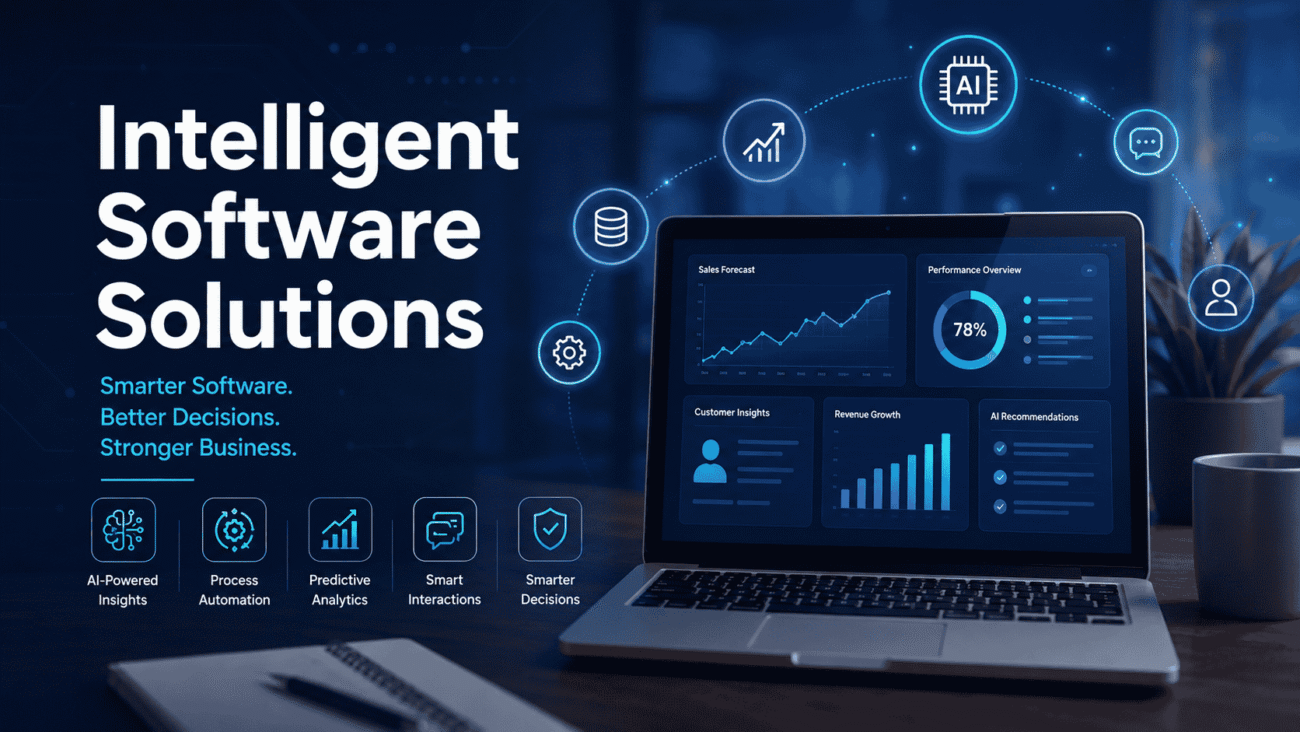
A client of mine once told me his team was “drowning in spreadsheets, but somehow still guessing.” That line stuck with me, because it sums up why so many businesses go looking for something smarter than what they’ve got. Not more software. Better software. Software that actually thinks a little Intelligent Software Solutions.
Intelligent software solutions are the systems built to do exactly that. They learn from data, adjust as conditions change, and quietly take over tasks that used to eat up entire afternoons — the kind of work nobody wants but everybody needs done.
I’m not here to sell you a buzzword. I’ve spent years watching small businesses and enterprise teams roll these tools out, and I’ve seen it go both ways: some teams transform how they work, others burn budget on a platform that never earns its keep. What follows is the honest version — what these systems really are, where they shine, where they let you down, and how to choose one without regretting it six months later.
What Are Intelligent Software Solutions, Really?
Strip away the marketing language, and intelligent software solutions are just programs built to do more than follow fixed instructions. They lean on data, patterns, and sometimes machine learning to make decisions, predict outcomes, or handle work that used to require an actual person’s judgment call.
Here’s a comparison I like to use. A basic calculator does precisely what you tell it, nothing more. A spreadsheet with some intelligence baked in, on the other hand, notices unusual spending before you do and flags it. One waits for instructions. The other pays attention.
That shift is happening across nearly every industry right now, whether businesses realize it or not. Software has stopped being just a task-executor. Increasingly, it’s a decision-assistant — and honestly, that’s a bigger change than most people give it credit for.
A Simple Way to Picture It
Picture a customer service inbox. A traditional system routes emails using rigid rules — anything with “refund” in the subject line goes straight to billing, no matter what the email actually says.
An intelligent system, by contrast, reads the actual content of the message. It picks up on tone, checks the customer’s order history, and routes the message to the right person — sometimes even drafting a reply on its own. That gap, between rule-following and understanding, is really the whole difference between old-school automation and genuine intelligent software.
How Intelligent Software Solutions Differ From Traditional Software
It’s tempting to lump all business software into one bucket, but the gap between traditional tools and intelligent ones is wider than most people assume.
| Feature | Traditional Software | Intelligent Software Solutions |
|---|---|---|
| Decision-making | Follows fixed rules | Adapts based on data patterns |
| Learning ability | None | Improves over time with use |
| Setup effort | Usually simpler | Often needs data prep and training |
| Flexibility | Rigid, needs manual updates | Adjusts automatically to new inputs |
| Best for | Repetitive, predictable tasks | Complex, variable, data-heavy tasks |
And to be clear, neither one wins across the board — that’s a trap I see people fall into constantly. A small bakery tracking inventory doesn’t need machine learning; a chalkboard and a Tuesday habit would probably do fine. A logistics company routing thousands of daily deliveries? That’s a different story entirely.
Real-World Scenarios Where These Tools Make a Difference
I’ve watched this play out across a handful of industries, and a few examples are worth walking through in detail.
Retail and inventory management. A mid-sized retailer I worked with used to guess how much stock to order each season — and I mean actually guess, based on gut feeling and last year’s numbers. After switching to a smarter inventory system that analyzed past sales, weather patterns, and local events, overstock dropped significantly. Nobody on the team had to babysit spreadsheets at midnight anymore.
Healthcare scheduling. Clinics fighting a constant battle with no-shows started using scheduling software that predicts which appointments are likely to get missed, based on patient history. Front desk staff could then send targeted reminders instead of blasting the same generic text to everyone on the books.
Customer support. Companies handling high email or chat volume now lean on intelligent triage systems that sort, prioritize, and sometimes respond to common questions instantly. That frees human agents to focus on the tricky cases that genuinely need a person’s attention — which, frankly, is where they should be spending their time anyway.
Financial fraud detection. Banks and payment processors depend on systems that flag unusual transaction patterns in real time. A rules-based system simply can’t move fast enough at that scale, not even close.
None of these are hypothetical. They’re the everyday reality for businesses that adopted the right tools early and, just as importantly, built their processes around them instead of bolting the software on and hoping for the best.
Types of Intelligent Software Solutions
Not all intelligent software fits the same mold, and lumping them together is where a lot of buying decisions go sideways. Here’s a quick breakdown of the categories you’ll run into most often.
- Predictive analytics tools — forecast trends like sales, demand, or churn based on historical data.
- Process automation platforms — handle repetitive workflows like invoicing, onboarding, or approvals.
- Natural language tools — power chatbots, transcription, and email sorting by understanding written or spoken text.
- Recommendation engines — suggest products, content, or actions based on user behavior.
- Decision-support systems — help managers weigh options using real-time data dashboards.
In practice, most businesses end up using a mix of these rather than betting everything on one platform. That’s usually the smarter play.
The Pros and Cons Nobody Talks About Enough
Plenty of articles will praise intelligent software solutions without ever mentioning the trade-offs, which does readers a disservice. So here’s a more balanced look, warts and all.
Pros
- Saves time on repetitive or data-heavy tasks
- Reduces human error in high-volume processes
- Improves over time as it processes more data
- Can surface insights a person might genuinely miss
- Scales more easily than manual processes ever could
Cons
- Requires clean, organized data to work well
- Can be expensive to set up properly
- Needs occasional human oversight to catch mistakes
- Comes with a learning curve for staff who aren’t tech-savvy
- Isn’t always transparent about how it reaches conclusions
That last point matters more than people expect, and I’d argue it’s the one most often ignored. If a system denies a loan application or flags a transaction, you need to understand why — not just shrug and accept the output blindly, because “the algorithm said so” isn’t an answer anyone should settle for.
Common Mistakes Businesses Make When Adopting Intelligent Software
I’ve watched the same mistakes repeat themselves across different companies, different industries, same disappointing result.
Buying the tool before defining the problem. Teams get excited about a flashy platform, sign the contract, and only halfway through implementation realize it doesn’t actually solve what they needed fixed in the first place.
Ignoring data quality. Intelligent software is only as good as what you feed it — a lesson I’ve watched people learn the hard way. Messy, inconsistent, or outdated data leads to messy, inconsistent, outdated results. There’s no shortcut around this one.
Skipping staff training. Even the smartest system fails if the people using it don’t understand how to work with it, or worse, don’t trust its output enough to actually use it.
Expecting instant results. Many of these tools need time to learn patterns specific to your business. Judging performance after two weeks is almost always premature, and it’s a common reason good tools get abandoned too early.
No fallback plan. When the system goes down or produces an odd result — and eventually, it will — teams without a manual backup process end up completely stuck.
Expert Tips for Choosing the Right Solution
After years of watching what works and what flops, here’s what I’d actually tell a friend starting this process.
Start with a small, specific problem rather than trying to overhaul everything at once. A focused pilot project will teach you far more than a company-wide rollout gone sideways ever will.
Ask vendors direct questions about how their system handles errors or edge cases. If they can’t explain it clearly and confidently, take that as a red flag worth noting.
Check how much your team will actually need to manage the system day-to-day. Plenty of tools promise “set it and forget it,” but in reality need regular tuning to stay useful.
Involve the people who’ll actually use the software in the decision process. Tools chosen purely by leadership, without any frontline input, tend to sit underused within a year.
Budget for training time, not just the software cost itself. The upfront license fee is rarely the full financial picture, and pretending otherwise sets everyone up for a rough surprise later.
Is Intelligent Software Worth the Investment?
For most growing businesses, yes — but timing and scope matter more than people think. A five-person startup probably doesn’t need a full predictive analytics suite; that’s overkill dressed up as ambition. A company processing thousands of customer interactions a month, though, almost certainly does.
The smartest approach is matching the tool to the actual bottleneck in your operations, not chasing whatever’s trending on LinkedIn this quarter. And if you’re not sure where that bottleneck actually is, that’s usually the first thing worth figuring out — before you even start shopping for software.
FAQs
What makes software “intelligent” instead of just automated?
Automated software follows fixed rules you set in advance. Intelligent software analyzes data and adjusts its behavior based on patterns it detects, often getting more accurate the more it’s used.
Do small businesses actually need intelligent software solutions?
Not always, and it’s fine to admit that. Many small businesses do perfectly well with simpler automation tools. Intelligent software tends to earn its keep once you’re dealing with large amounts of data or repetitive decisions that a basic tool just can’t handle well.
How long does it take to see results after implementation?
It varies quite a bit, depending on the tool and how much data it needs to learn from. Some systems show value within weeks. Others, especially ones relying on machine learning, may take a few months to become genuinely useful. Timelines depend heavily on data quality and setup, so it’s worth checking current benchmarks for your specific type of software rather than assuming a one-size-fits-all timeline.
Can intelligent software replace human employees entirely?
Rarely, and honestly, that’s usually not even the goal. Most of these tools work best when they handle repetitive or data-heavy tasks, freeing people to focus on judgment calls, relationships, and creative problem-solving — the stuff software still isn’t great at.
What’s the biggest risk of relying on intelligent software?
Blind trust, plain and simple. If a business stops questioning the output or lets data quality slide, the system can quietly produce flawed results that go unnoticed until they cause real, sometimes expensive, damage.
Key Takeaways
Intelligent software solutions aren’t magic, and I’d push back hard on anyone who tells you they are. But they’re not hype either. Used well, they genuinely change how businesses handle repetitive work, spot patterns, and make faster decisions — as long as they’re set up thoughtfully and matched to a real, specific problem instead of a vague sense that “we should probably automate something.”
The businesses that get the most out of these tools are rarely the ones with the biggest budgets. They’re the ones who start small, keep their data clean, train their teams properly, and stay genuinely involved instead of handing everything over to the algorithm and walking away. Find the actual bottleneck in your operations, pick the tool built to solve it, and the payoff tends to follow on its own.
