There’s a specific kind of regret that comes from unboxing a music gadgets, using it twice, and then watching it collect dust on a shelf. I know because I’ve done it — more than once. After years of testing gear for my own home studio, buying things I didn’t need, and returning things I should have researched better, I’ve got a pretty clear sense of what’s worth your money in this space and what’s just clever marketing wrapped around a mediocre product.
So this isn’t going to be another “top 10 gadgets” list stitched together from spec sheets. It’s a real breakdown, built from hands-on use, for anyone shopping in this category — the bedroom producer piecing together a first setup, the gigging guitarist who needs gear that survives a Tuesday night show, the casual listener who just wants their playlists to sound less tinny, or the person buying a gift for the musician in their life and hoping they don’t get it wrong.
What Counts as a “Music Gadgets” Anyway?
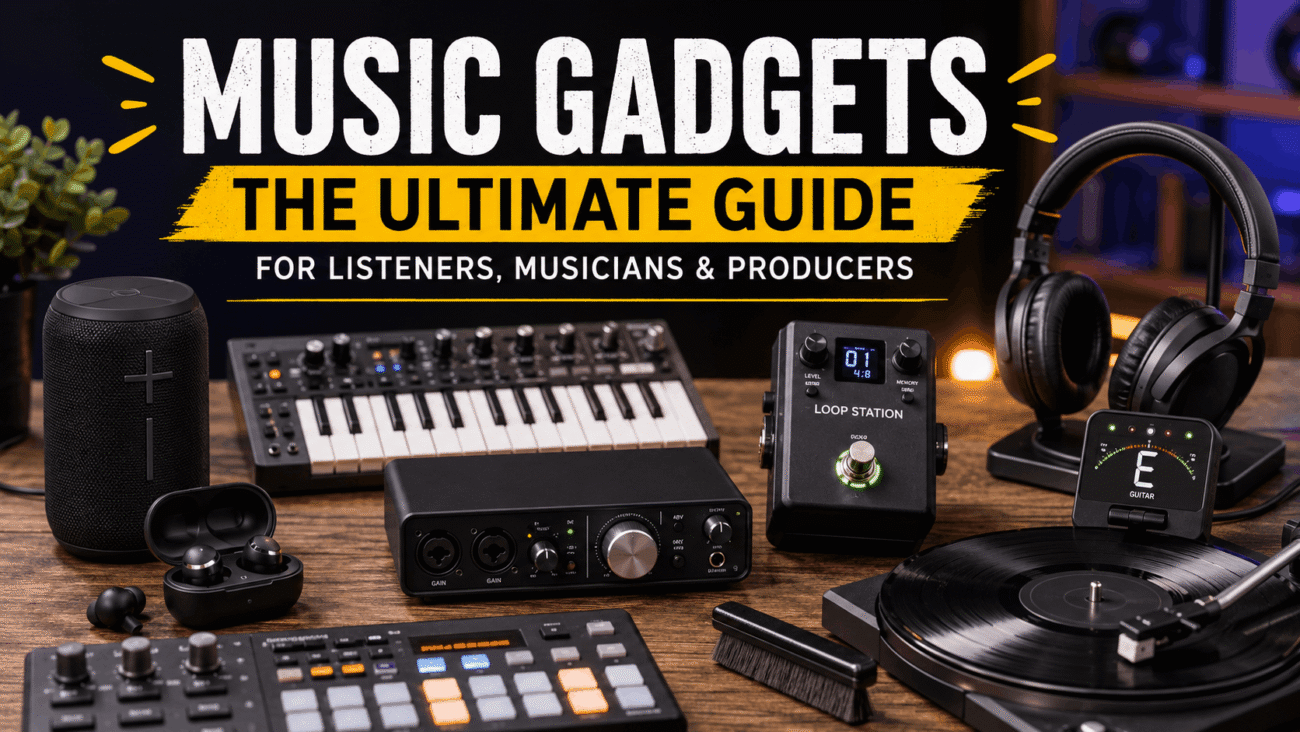
Honestly, the term gets thrown around pretty loosely. For this guide, I’m using it to mean any standalone device built for creating, playing, recording, or upgrading how you experience music. That covers a lot of ground:
- Portable synthesizers and drum machines
- Bluetooth speakers and wireless earbuds
- MIDI controllers and audio interfaces
- Smart tuners, metronomes, and looper pedals
- Vinyl accessories and turntable upgrades
- AI-powered practice tools
Some of these are built for people who just want better sound in their living room. Others are made for musicians who need to write, record, or perform. Those two groups have very different needs, so I’ve split the rest of this guide around that distinction rather than lumping everything together.
Music Gadgets for Listeners
If you’re not touching a DAW or learning scales anytime soon, and you just want your music to sound noticeably better, start here.
Bluetooth Speakers Worth Your Money
Portable speakers have basically become a household staple at this point, but the quality gap between models is wider than most people expect. I learned this the hard way — I grabbed a speaker during a flash sale for a backyard party, and by the second use, the bass was already distorting at anything above moderate volume. Cheap speakers cut corners on the driver first, not just the plastic shell, and you can hear it.
When you’re comparing speakers, don’t trust the battery life number on the box — it’s almost always tested at a whisper-quiet volume that nobody actually uses. Instead, look at three things that matter more in practice: real-world battery performance, an IP rating if you’ll ever take it outside, and whether it supports stereo pairing with a second unit. That last feature, in particular, is underrated. Pairing two budget speakers together often sounds better than splurging on one premium unit, for less total money.
Wireless Earbuds and Headphones
This category is absolutely saturated, and the differences that actually matter aren’t always what the marketing highlights. Noise cancellation quality swings wildly between price tiers, and codec support — which affects how much audio detail survives the Bluetooth handoff — gets overlooked constantly.
If you consider yourself even a little bit of an audiophile, check whether your earbuds support higher-quality codecs like aptX or LDAC — and then check whether your phone actually supports them too. This trips people up more than you’d think. iPhones, for example, don’t support LDAC, so paying extra for that feature is money down the drain if you’re an Apple user.
Vinyl and Turntable Accessories
Vinyl isn’t a fad that’s fading — if anything, the accessory market around it keeps growing. And a basic turntable can sound dramatically better with a few smart, inexpensive tweaks:
- A quality phono preamp, if your setup doesn’t already have one built in
- A carbon fiber record brush to cut down on static and dust
- A better stylus, since the stock needle on entry-level turntables is usually the weakest link in the whole chain
I swapped the stylus on my starter turntable after about a year of use, mostly on a whim, and the jump in clarity genuinely surprised me. It’s a small fix, it doesn’t cost much, and it’s the first upgrade I’d recommend to any vinyl beginner who feels like something’s missing from their sound.
Music Gadgets for Musicians and Producers
This is where things get more technical — and where buying the wrong gadget can actually slow your creative process down instead of speeding it up.
MIDI Controllers
A MIDI controller looks like a keyboard, or sometimes a grid of pads, but it doesn’t make any sound on its own. Its whole job is sending note and control data to your computer or software instrument.
Beginners tend to over-buy here. I’ve seen people grab a 61-key controller loaded with knobs and faders when a compact 25-key model would’ve covered nearly everything they actually do. Unless you’re performing live on keys, a smaller controller saves desk space and cash without really limiting what you can create.
Audio Interfaces
If recording vocals, guitar, or any live instrument is on your radar, an audio interface isn’t a luxury — it’s the foundation. Your laptop’s built-in mic input was never designed for real recording, and using it introduces noise and latency that no plugin or software trick will fully undo later.
A basic two-input interface handles most home recording setups just fine. Don’t let a salesperson talk you into eight inputs unless you’re tracking a full band at once or running a small studio for paying clients.
Portable Synths and Grooveboxes
This category has exploded, and I get why. These devices let you sketch melodies, basslines, and drum patterns on a small standalone unit, away from a screen, before exporting or recording the results later. There’s something genuinely freeing about writing music without a monitor staring back at you.
That said, the learning curve is real, and I won’t pretend otherwise. A lot of these devices rely on menu-diving interfaces, meaning you’re tapping through several screens just to tweak a single parameter. If clunky menus tend to frustrate you — and they frustrate plenty of people — try one in person first, or at minimum, watch an unscripted hands-on video before you buy.
Loop Pedals and Smart Tuners
For guitarists and solo performers, a loop pedal can turn one instrument into a full arrangement in real time. Of everything on this list, it’s one of the more genuinely creative tools, since it changes how you write and perform rather than just cleaning up your sound.
Smart tuners have quietly gotten better too. Clip-on models with improved vibration sensors now hold up reliably even in loud, chaotic rehearsal spaces — a real upgrade from older tuners that used to choke the moment a drummer started warming up nearby.
Comparison: Popular Music Gadgets Categories
| Gadget Type | Best For | Typical Price Range | Learning Curve |
|---|---|---|---|
| Bluetooth Speaker | Casual listening, parties | Budget to mid-range | Low |
| Wireless Earbuds/Headphones | Daily listening, commuting | Budget to premium | Low |
| MIDI Controller | Music production, songwriting | Budget to mid-range | Moderate |
| Audio Interface | Home recording | Budget to mid-range | Moderate |
| Portable Synth/Groovebox | Sound design, experimentation | Mid-range to premium | High |
| Loop Pedal | Live performance, solo acts | Budget to mid-range | Moderate |
A quick note on pricing: it shifts constantly depending on sales, model year, and retailer, so treat these as rough guides and check current listings before locking in a budget.
Common Mistakes People Make Buying Music Gadgets
I’ve made a few of these myself. I’ve watched friends make the rest.
Buying based on specs alone. A speaker boasting a bigger wattage number doesn’t automatically sound better. Room acoustics, driver quality, and how the device is tuned matter far more than a number printed on a box.
Skipping the return policy. Gadgets with a real learning curve — grooveboxes, MIDI controllers, that sort of thing — often feel completely different after a week of actual use than they did on day one. Buy from retailers with a fair return window whenever you’re not 100% sure.
Ignoring compatibility. Not every audio interface plays nicely with every operating system, and not every controller is class-compliant — some need extra drivers just to function. Always double-check compatibility with your exact setup before you click purchase.
Overbuying for your skill level. A beginner producer doesn’t need a sixteen-track interface. A beginner guitarist doesn’t need a five-loop pedal with MIDI sync built in. Buy for where you are right now, and upgrade once you’ve genuinely outgrown the basics — not before, no matter how tempting the upgrade looks.
Forgetting about cables and accessories. This one sounds minor, but it catches people constantly. I’ve watched friends buy a great audio interface only to discover, box open, that they still need a separate cable, adapter, or power supply that wasn’t included. Check what’s actually in the box before you check out.
Pros and Cons of Going All-In on Music Gadgets
Pros:
- Portable creativity that doesn’t demand a full studio setup
- Many gadgets now deliver studio-quality results at consumer prices
- Standalone devices cut down on screen time compared to software-only workflows
- A low-friction way into music production without a huge upfront investment
Cons:
- Easy to accumulate gear you barely touch after the first month
- Some devices have genuinely steep learning curves that discourage beginners
- Battery-powered gadgets mean one more thing to remember to charge
- Compatibility headaches can turn an exciting purchase into a frustrating one
Expert Tips Before You Buy
Start with the one gap in your setup that’s actually holding you back — not a wish list. If you can’t record clean vocals, fix that first with an interface and a decent mic, rather than dropping money on a synth you don’t have a workflow for yet.
Watch real demo videos, not polished marketing clips. A slick five-minute unboxing tells you almost nothing about how a device actually feels three weeks into using it during a real session.
Ask in online communities before buying anything niche. Forums and subreddits built around music production are full of people who’ve already made the mistake you’re about to make — and most of them are happy to save you the trouble, if you just ask.
Budget for accessories from the start. Cases, cables, and stands add up faster than most people expect, sometimes costing more collectively than the device itself, so factor that into your total spend rather than just eyeing the sticker price.
FAQs
Do I need an audio interface if I only record with a USB microphone?
Not necessarily. USB microphones convert the audio signal on their own, so a separate interface isn’t required. An interface becomes useful once you want to record instruments with XLR microphones or connect other line-level gear.
Are portable synths good for beginners, or should I start with software?
Software instruments are usually cheaper and easier to start with, since most DAWs already include built-in synths. A hardware synth makes more sense as a second step, once you’ve got a feel for basic sound design and want a more hands-on, screen-free way of working music gadgets.
What’s the actual difference between cheap and expensive Bluetooth speakers?
The biggest differences usually come down to driver quality, bass response at higher volumes, and overall build durability. Cheaper speakers often sound fine at a low volume but start distorting or losing clarity the moment you turn things up.
Can I use a MIDI controller without a computer?
Some standalone controllers are built to work with a computer only, while others can connect directly to compatible mobile apps or hardware synths. Check the specific device’s compatibility page before assuming it’ll work computer-free music gadgets.
How do I know if a music gadgets is actually worth the price?
Look past the spec sheet and read reviews from people who’ve used the device for weeks, not just their first impression out of the box. And honestly, ask yourself whether it solves a real gap in your current setup — or whether it’s just a well-marketed impulse buy.
Final Thoughts
The music gadgets market is bigger, weirder, and more exciting than it’s ever been. But bigger doesn’t mean every shiny new device deserves a spot on your desk or in your gig bag. The gadgets that actually earn their keep are the ones solving a real problem — better sound for listeners, smoother recording for producers, more expressive performance for musicians on stage.
Before you buy anything, be honest with yourself about what you actually need right now, not what looked impressive in a five-minute demo video. Start small. Learn the gear you already own before adding to the pile. Add something new only once you’ve genuinely hit a limitation with what you’ve got. That habit alone has saved me more money — and more drawer space — than any single piece of gear ever has.
